

Strip away the valet parking and the tasting menus, and the difference between a 5-star hotel and everything below it is decided in one place: the room. It is where the guest spends the most unaccompanied time, where marketing promises are tested against reality, and where the top tier either earns its rating or quietly fails it.
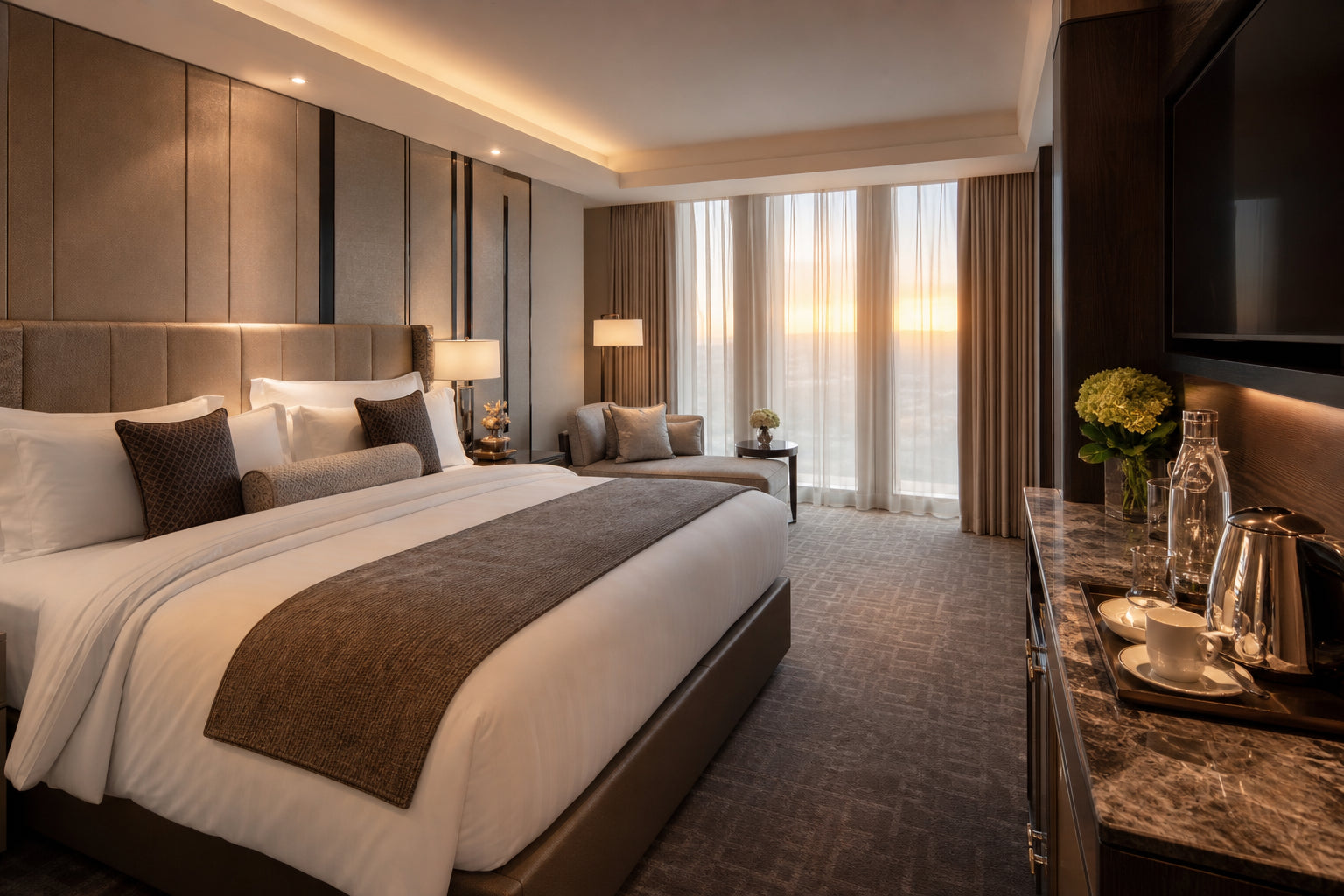
What is instructive for any operator — whether or not five stars is the ambition — is that 5-star room standards are not mysterious. They are specific, observable and, in large part, transferable. This article breaks down what actually distinguishes a 5-star room across space, materials, amenities, equipment and detail, and what operators at every level can borrow from it.
Space and layout: generosity with a purpose
The first thing a 5-star room communicates is space — but not raw square metrage alone. The distinguishing standard is how the space is zoned. A top-tier room gives the guest distinct areas that do not fight each other: a sleeping zone, a working or writing surface, a place to sit that is not the bed, luggage space that does not block a walkway, and a bathroom that two people can use without negotiation.
The practical markers operators look for:
- Clear circulation — a guest can move from door to bed to bathroom to wardrobe without squeezing past furniture.
- A genuine luggage solution: a rack or bench, wardrobe depth for cases, and hanging space that accommodates more than four hangers.
- Surfaces where guests actually need them — beside the bed, at the desk, next to the tea and coffee station.
- Sightlines that hide the working parts of the room: bins, cabling, consumable storage.
Smaller properties cannot conjure square metres, but zoning is a design discipline, not a floor-area one — and it is the part of 5-star spatial standards most worth copying.
The bed and materials: where budgets are spent silently
Five-star properties concentrate spend where guests spend time asleep or barefoot. The bed is the emblem: a high-quality mattress, layered bedding, generous pillows in more than one firmness, and linen that survives commercial laundering while still feeling substantial. None of it is showy; all of it is felt.
The same logic runs through materials. Flooring, upholstery and worktops in a 5-star room are chosen to feel good on contact and to look new after years of daily service — which is a harder specification than merely looking expensive on day one. The standard, in other words, is durability experienced as luxury: nothing chipped, nothing peeling, nothing that betrays the traffic the room actually carries.
Amenities: completeness, not clutter
A persistent misconception is that 5-star rooms distinguish themselves by piling on amenities. In practice the top-tier standard is completeness — everything a guest could reasonably need is present, working and well-presented — combined with restraint in how it is displayed.
The amenity baseline in a 5-star room typically covers:
- A full tea and coffee service — a quality kettle or coffee machine, proper cups, and a presented selection rather than a scatter of sachets.
- A stocked, quiet minibar or fridge — increasingly specified for silence, because refrigeration noise is fatal to the sleep standard.
- A functioning in-room safe sized for a laptop, not just a passport.
- A capable hair dryer — one of the most-handled and most-judged appliances in the room.
- Iron and ironing board, or a pressing service that is genuinely frictionless to use.
- Considered small items: quality hangers, a proper bin in room and bathroom, bathrobes and slippers, and bathroom amenities that match the property's tier.
The standard that separates five stars is that every one of these items works first time, matches the room's finish, and appears where the guest expects it. A luxury room with a wheezing hair dryer is a contradiction guests notice instantly. Operators benchmarking upwards can specify the appliance layer from the Roomwell products collection, which is built around exactly this consistency-first principle.
Equipment and environment: control in the guest's hands
Beyond the amenity list, 5-star rooms are distinguished by how much of the room's environment the guest can control without effort. Lighting is layered — ambient, task and bedside — and switchable from the bed. Heating and cooling respond room-by-room rather than floor-by-floor. Blackout is genuine, not decorative. Sockets and charging points are where hands actually reach: both bedsides, the desk, beside the seating.
Acoustic standards belong here too, and they are among the least visible and most defining. Top-tier rooms are engineered and equipped for quiet: doors that close softly, appliances selected for low noise — the silent minibar being the classic example — and housekeeping practices that protect sleeping hours. A guest may never name the silence, but it is a large part of what "five-star sleep" means.
Consistency: the invisible standard
Everything above describes a single excellent room. What actually defines a 5-star operation is that room repeated — across every floor, every day, every turnover. Consistency is the invisible standard behind the visible ones, and it is delivered by discipline rather than budget: written room specifications, standardised equipment across the estate, scheduled preventive maintenance, and inspection that catches drift before guests do.
This is also the standard most available to operators outside the luxury tier. A three-star property cannot install marble bathrooms, but it can absolutely ensure that every room has the same working kettle, the same complete tray, the same tested safe and the same faultless presentation — and guests reward that reliability at every price point.
What operators at any level can take from the top tier
Benchmarking against 5-star standards is not about imitation; it is about extraction. The transferable lessons:
- Spend where guests touch. Beds, showers, kettles, hair dryers — contact points repay investment; spectacle does not.
- Specify completeness. Define the full amenity and equipment list per room type and never release a room that falls short of it.
- Buy for silence and durability. Quiet appliances and hospitality-grade equipment are 5-star decisions available at every tier.
- Make consistency the headline standard. One identical, reliable experience across the estate beats occasional brilliance.
The top tier's real secret is that its standards are systems, not gestures — and systems can be adopted by any operator willing to write them down and hold them.
Quick answer: Five-star rooms are not defined by chandeliers. They are defined by consistency, completeness and detail — standards any operator can study. Here is what actually sets the top tier apart.
Benefits
- Helps travellers match spend to how they will use the room.
- Gives operators a clearer investment map by quality level.
- Reduces expectation mismatches that drive poor reviews.
- Clarifies where appliances, bathrooms and service depth should differ.
Features
- 3-star focus: clean essentials, efficient layout, reliable kit.
- 5-star focus: space, anticipatory service, amenity choice and finish.
- Shared non-negotiables: sleep quality, bathroom cleanliness, working appliances.
- Practical decision cues for destination-led vs room-led trips.
Frequently asked questions
What is the real difference between 3-star and 5-star hotels?
3-star hotels sell essentials done well; 5-star hotels add living space, deeper staffing, richer amenities and higher finish.
Is a 3-star hotel good enough for vacation?
Yes when you prioritise location, cleanliness and sleep over suite space and anticipatory service.
Do star ratings mean the same everywhere?
No. Schemes differ by country — verify with recent reviews, not the badge alone.
Which features matter most at every star level?
Comfortable beds, spotless bathrooms, quiet nights and appliances that work first time.
Roomwell supplies UK hotels at every level with the equipment layer of that system: quiet minibars, quality kettles, hair dryers, safes, ironing equipment and room accessories specified for hospitality use. Browse the Roomwell range, or contact our team to benchmark and specify your rooms.