

The in-room amenity list used to be one of the most stable documents in hospitality: kettle, trouser press, hair dryer, a fridge if you were lucky. That stability has gone. Guest expectations now shift with the technology in their pockets, the values they bring from home and the habits formed across millions of stays — and the amenity offer that felt current five years ago can read as dated today.
Quick answer: Guest expectations of the in-room offer are shifting — towards quiet, charging, sustainability and wellness. A level-headed look at the amenity trends worth adopting and the fads worth skipping.
Benefits
- Protects guest sleep with quieter cooling in the room.
- Supports higher review scores linked to rest and comfort.
- Gives operators a clear specification choice (absorption vs compressor).
- Improves perceived luxury when stock presentation is clean and chilled.
Features
- Quiet cooling technology suited to bedside or cabinet placement.
- Solid or glass door options for brand presentation standards.
- Capacities matched to room type rather than one estate-wide default.
- Hotel-grade build for continuous hospitality duty cycles.
Frequently asked questions
Why do silent minibars matter for hotel reviews?
Because noise at night is a common complaint. A quieter unit protects sleep and reduces negative comments about humming fridges.
Is absorption better than compressor for guest rooms?
For most UK guest rooms, absorption is preferred for near-silent operation. Compressor units suit warmer loads or non-sleep spaces.
What should operators check when installing a minibar?
Ventilation clearances, level fit, door finish, capacity by room type, and that the unit does not rattle against cabinetry.
Do guests expect a stocked minibar in every hotel?
Expectations rise with star level. Mid-scale rooms often use an empty fridge; luxury rooms more often stock a quiet chilled minibar.
For operators, the challenge is not spotting trends — the industry press does that weekly — but judging which ones represent durable shifts in expectation and which are expensive fads. This article surveys the amenity trends with real momentum in UK hotels and offers a practical filter for deciding what belongs in your rooms.
Trend one: the quiet room becomes an amenity in itself
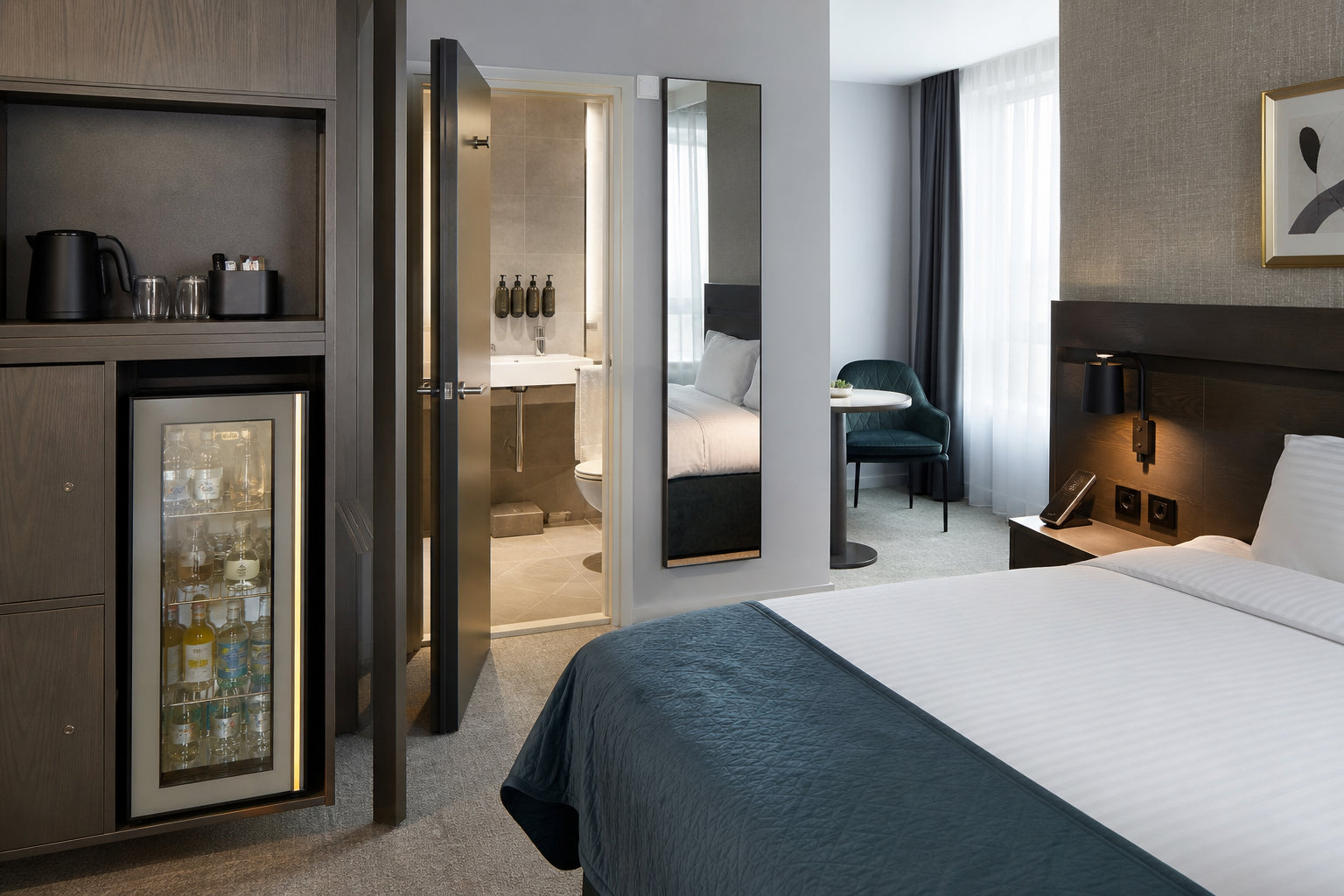
The most significant shift is barely visible: quiet has moved from a nice-to-have to an expected feature, and equipment choices are following. The clearest example is the minibar. Traditional compressor fridges cycle on and off through the night with a hum guests increasingly refuse to tolerate; silent absorption minibars, with no compressor at all, have become the default specification for any operator who takes sleep seriously.
The same logic is spreading through the room: quieter air conditioning, soft-close doors and drawers, kettles chosen partly for how gently they boil. Operators are learning to read their own reviews acoustically — "couldn't sleep because of the fridge" is a specification failure, not a guest quirk — and to buy accordingly.
Trend two: power and charging everywhere hands reach
Guests now arrive with two to four devices each, and their sharpest in-room frustration is a socket audit that fails: nothing beside the bed, one outlet behind the desk, an adaptor needed for everything. The trend response is straightforward and largely retrofittable — bedside USB and USB-C points, sockets integrated into headboards or bedside shelves, and desk-level power that does not involve crawling under furniture.
The direction of travel is towards charging as furniture: bedside units and lamps with built-in ports, and wireless charging pads on desks and nightstands. Operators refreshing rooms should treat charging as an amenity line in its own right, specified per bedside rather than per room.
Trend three: sustainability guests can see
Environmental expectation has moved from tolerance of green measures to demand for them — but with an important nuance: guests respond to sustainability they can see and feel, not to claims. The visible amenity shifts with traction:
- Refillable dispensers replacing miniature toiletry bottles, now widespread across chains and independents alike.
- Filtered water stations or glass bottles replacing plastic bottled water in the room.
- Genuine recycling provision in the room — dual-compartment bins rather than a single bin and a promise.
- Longer-life equipment — durable kettles, hair dryers and appliances positioned as waste reduction as much as cost control.
The operator's discipline here is honesty: visible measures must be matched by real back-of-house practice, because guests have become quick to spot — and review — token gestures.
Trend four: the hospitality tray grows up
The tea-and-coffee station is having a quality moment. The trend is away from the apologetic corner tray — plastic kettle, UHT pots, two digestives — towards a small but genuine beverage experience: a well-made kettle, proper cups or glassware, better tea selections, cafetières or pod machines in higher categories, and fresh milk solutions instead of long-life capsules.
This is one of the highest-return trends to adopt because the tray is among the most-used amenities in the room and one of the cheapest to elevate. A visibly better kettle and a considered selection reads as a room upgrade at a fraction of refurbishment cost. Operators can specify the equipment layer — kettles and tray hardware suited to daily hotel use — from the Roomwell products collection.
Trend five: wellness touches move into the standard room
Amenities once reserved for spa properties are migrating into ordinary rooms: blackout done properly, better pillows with a menu of options, yoga mats available on request, air quality and temperature the guest can actually control. The common thread is that wellness in the room now means supporting the guest's own routines — sleep, exercise, recovery — rather than adding treatments.
For most operators, the accessible entry points are sleep-related: genuine blackout, quiet equipment as covered above, and bedding quality. These carry the further advantage of feeding directly into the review categories that matter most.
Trend six: technology that helps without demanding
In-room technology has passed through its gadget phase and settled into a more useful principle: technology should reduce friction, not introduce it. Casting to the TV from the guest's own device has outlasted proprietary entertainment systems; simple, reliable Wi-Fi has outlasted elaborate portals; a bedside control that dims everything has outlasted tablets that control the curtains after a firmware update.
The filter for operators is the first-attempt test: if a first-time guest cannot operate it correctly on the first attempt, it is not an amenity, it is a puzzle. The equipment that survives this test tends to be the quiet, boring kind — which is exactly the kind worth buying.
Separating durable shifts from fads
Across all six trends, three questions separate lasting expectation shifts from expensive noise:
- Does it serve a nightly behaviour? Charging, sleeping, making a hot drink and showering happen every stay. Amenities serving those behaviours compound; novelties serving occasional behaviours date quickly.
- Does it reduce friction or add it? Trends that remove effort (silent equipment, bedside power, refillables that never run out) endure. Trends that add steps rarely do.
- Can it be maintained across the estate? An amenity that cannot survive housekeeping turnover, staff churn and hard water is a pilot scheme, not a standard.
Applied honestly, this filter usually points the budget towards the unglamorous winners: quiet refrigeration, better kettles and trays, more power points, visible sustainability and sleep quality — the modern amenity core taking shape across UK hospitality.
Updating your amenity standard
The practical next step for any operator is to re-open the room specification document and test it against current expectation: where guests charge, how they sleep, what they now expect not to see in plastic. Trend adoption works best as a revision of the standard — applied consistently across the estate — rather than as scattered experiments in a few refurbished rooms.
Roomwell supplies UK hotels with the equipment behind the durable trends: silent minibars, quality kettles and hospitality tray hardware, hair dryers, safes and room accessories specified for hotel use. Browse the Roomwell range, or contact our team to bring your amenity standard up to date.