

Ask guests what technology they want in a hotel room and the honest answer is unglamorous: they want their phone to charge by the bed, the Wi-Fi to work without a fight, and the television to do what their one at home does. The industry has spent years experimenting with tablets, voice assistants and app-controlled everything, yet the reviews keep telling the same story — guests reward rooms where their own devices work effortlessly, and punish rooms where basic technology fails or fights them.
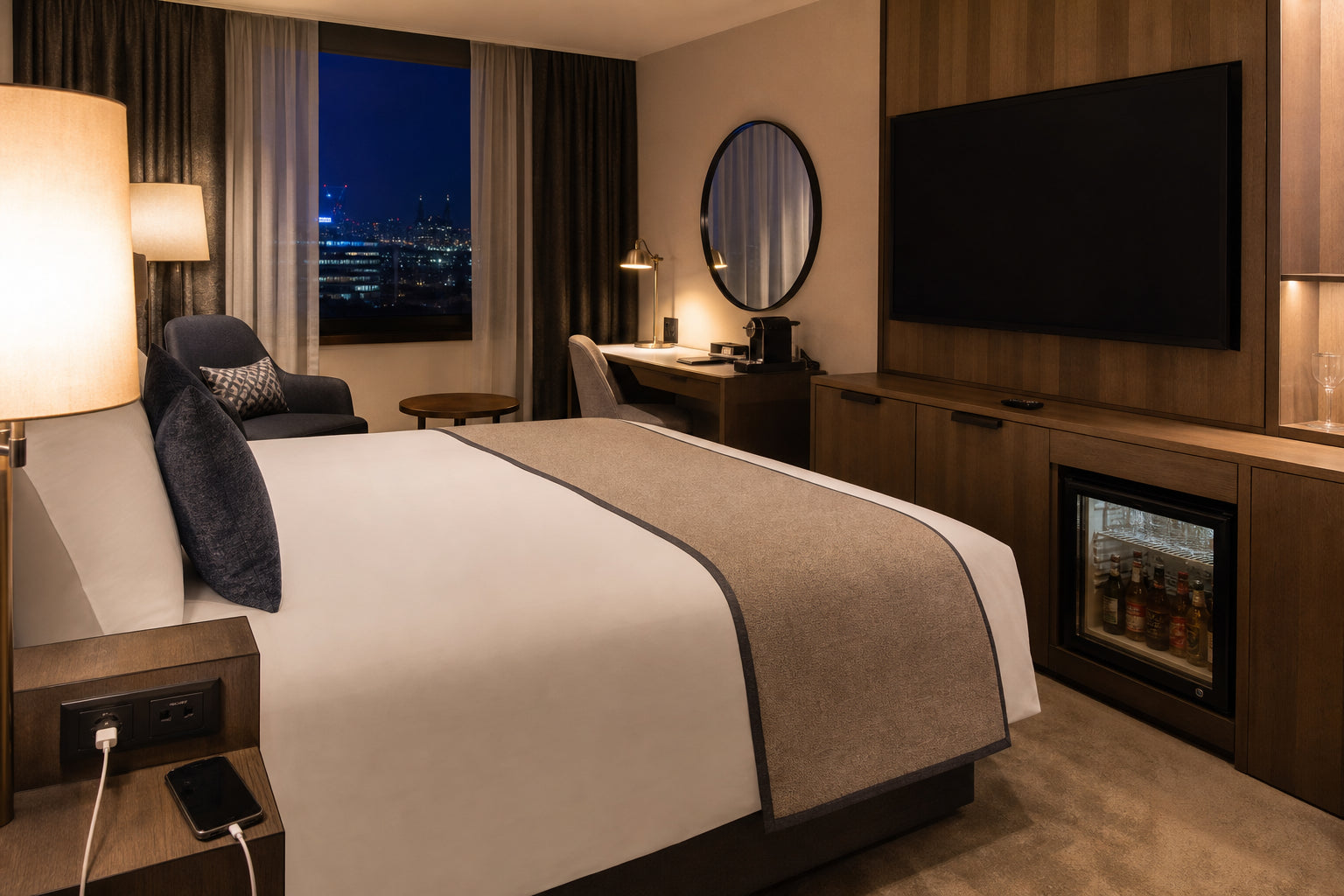
That is genuinely good news for operators, because it means the technology guests value most is also the most achievable. This guide works through the in-room technology decisions that shape reviews — connectivity, entertainment, power, smart controls and the quiet appliances that sit alongside them — with a focus on specifying for reliability rather than novelty.
Wi-Fi: the amenity guests treat as a utility
Wi-Fi has crossed the line from amenity to utility. Guests no longer thank a hotel for providing it, any more than they thank it for hot water — but they will absolutely penalise a property where it is slow, patchy or awkward to join. For business travellers a failed video call is a failed stay; for leisure guests, an evening of buffering is remembered at review time.
The specification points that matter:
- Coverage in the rooms, not just the lobby. Signal strength should be verified in the actual guest rooms — including bathroom-adjacent corners and upper floors — rather than assumed from the access-point plan.
- Capacity for real device counts. A couple now travels with four to six connected devices between them. Networks sized for one device per room fall over at full occupancy.
- A painless join. Every extra step — codes on slips of paper, logins that expire daily, portals that reject the third device — generates front-desk calls and irritation. The closer the experience is to "connect once, stay connected", the better.
- Free at a usable speed. Charging for basic access, or throttling it to push a paid tier, reliably surfaces in reviews as a grievance out of proportion to the revenue it earns.
Television and streaming: guests bring their own content
The in-room television has changed role. Guests increasingly arrive with their content — streaming subscriptions, downloads, and their own viewing habits — and the television's job is to let them use it on a bigger screen. A large channel line-up impresses far less than a set that lets a guest carry on watching what they were watching at home.
In practice, the options worth considering are:
- Casting or screen mirroring from the guest's own device, which keeps their logins on their phone rather than on your hardware.
- Hospitality smart TVs with guest-mode streaming apps that sign the guest out automatically at checkout — essential for privacy, since a previous guest's account left logged in is both a service failure and a data-protection problem.
- An accessible HDMI input as the simple fallback, so a guest with a laptop or streaming stick can connect without moving furniture to reach the back of the set.
Whatever the platform, the basics still decide satisfaction: a screen size appropriate to the viewing distance, a wall position watchable from the bed, a remote that works with fresh batteries, and a home screen that is not cluttered with promotional channels the guest must escape from every time the set is switched on.
Power and USB: the bedside socket is the new headboard test
If the kettle is the first appliance a guest touches, the bedside socket is the first thing many of them look for. Charging a phone overnight, within reach of the bed, is now a baseline expectation — and rooms that fail it force guests into the memorably bad experience of charging their phone on the floor by the desk, or unplugging a lamp to do it.
A practical power specification for a modern room:
- Sockets on both sides of the bed, at mattress height or on the bedside unit — not hidden behind the headboard.
- Integrated USB outlets (including USB-C, which is rapidly becoming the default connector) so guests can charge without hunting for their plug adaptor — particularly valued by international visitors.
- Sockets at the desk and near the mirror, because laptops, hair tools and shavers all compete for power in predictable places.
- Enough free sockets. Audit each room type with everything plugged in — lamps, TV, kettle, minibar — and count what is genuinely left for the guest. The answer is often zero, which explains the multi-way adaptors housekeeping keeps finding.
Smart controls: convenience is the test, not novelty
Smart room technology — app-controlled lighting, automated blinds, voice assistants, tablet-driven everything — divides guests more than any other category. Used judiciously, it removes friction; used enthusiastically, it creates the modern horror story of a guest at midnight unable to work out how to turn the lights off.
A sensible rule of thumb: automation should never remove the obvious manual option. A light switch by the door and by the bed, a thermostat a tired guest can understand in five seconds, curtains that can be pulled by hand — these are the baseline. Smart layers on top of them can genuinely delight; smart layers instead of them generate calls to reception and one-star anecdotes.
Operators should also weigh the ownership cost honestly. Every additional system is something housekeeping must check, maintenance must support and new staff must learn. Technology that saves the guest ten seconds but costs the operation hours of support rarely pays its way. Introduce smart features where they solve a real problem — occupancy-based heating control is a good example — rather than as a headline.
Taming charging clutter: the tidy room is a specified room
There is a visual cost to the device-heavy stay: cables trailing across bedside units, adaptors stacked into sockets, a desk lost under chargers. Guests bring the devices, but the room determines whether the result looks like clutter or convenience — and clutter reads as an unconsidered room even when everything technically works.
The remedies are mostly furniture-level decisions:
- Bedside units with built-in sockets and a surface actually large enough for a phone, a watch and a glass of water.
- Cable outlets and tidies at the desk so a laptop can be powered without a cable crossing the walkway.
- A deliberate "charging spot" in the room layout, so devices congregate in one tidy place instead of colonising every surface.
- Housekeeping standards that include straightening visible cables and checking sockets at turnover, just as cushions and trays are reset.
Expectations versus complexity: where to draw the line
The recurring theme across all of this is a gap between what guests expect and what adds complexity. Guests expect their own technology to work: fast Wi-Fi, a co-operative TV, reachable power. They do not, on the whole, expect the room itself to be clever — and every layer of cleverness carries a support burden and a failure mode.
A useful discipline when evaluating any new in-room technology is to ask three questions. Does it work for the least technical guest you host, with no instructions? Does it fail gracefully — is there a manual fallback when it misbehaves? And who supports it at 11pm on a Saturday? Technology that passes all three tends to improve reviews; technology that fails any of them tends to generate the anecdotes that headline them.
Quiet appliances: the tech-adjacent comfort guests feel but rarely name
One category of in-room equipment shapes the "technology experience" without being thought of as technology at all: the appliances that share the room with the sleeping guest. A humming minibar, a rattling extractor or a ticking heater undoes the comfort that every other specification worked to create — and noise complaints, once earned, are among the most damaging in reviews because they speak to the one thing a hotel room must deliver: sleep.
Silent-running absorption minibars are the clearest example. Unlike compressor units, they cool without the cyclical hum that light sleepers notice the moment the room goes quiet — which is precisely when guests are trying to fall asleep. Specifying quiet operation for anything that runs overnight — minibars, fridges, air handling — is as much a part of the modern technology stack as the Wi-Fi, because the guest experiences them the same way: invisibly when right, unmistakably when wrong.
The same logic extends to the rest of the appliance set. Kettles that boil without rattling, hair dryers that perform without screaming, and safes with simple, reliable keypads all contribute to a room that feels effortless — the quality guests describe, accurately if vaguely, as "everything just worked".
Specifying for the stay guests actually have
Modern in-room technology is less about installing the future than about removing friction from the present. Get the utilities right — coverage, capacity, power where guests need it. Let guests bring their own content to a television that co-operates. Add smart features only where they solve real problems and always alongside manual controls. And treat quiet, reliable appliances as part of the technology offer, because the guest's ears will.
Rooms specified this way rarely earn breathless praise for their gadgetry — they earn something more valuable: the absence of complaint, and reviews that talk about how easy and restful the stay was.
Quick answer: Guests do not want a futuristic room — they want their own technology to work effortlessly in yours. Here is how to specify Wi-Fi, TV, power, charging and smart controls that satisfy modern expectations without creating new complaints.
Benefits
- Reliable in-room tech reduces frustration and call volume.
- Clear controls improve accessibility for all guests.
- Streaming-ready Wi-Fi supports leisure and hybrid work stays.
- Standardised devices simplify training and replacements.
Features
- Stable Wi-Fi with enough capacity for video use.
- Simple TV/streaming setup guests can use without support.
- USB / charging points in sensible bedside locations.
- Optional smart controls that fail gracefully to manual use.
Frequently asked questions
What technology do guests expect in every room?
Fast Wi-Fi, easy TV use and enough charging points near the bed and desk.
Should hotels install complex smart-room systems?
Only if staff can support them and guests can override simply. Reliability beats novelty.
How does tech affect reviews?
Login friction, dead remotes and weak Wi-Fi create outsized negative comments.
What is a practical upgrade path?
Fix Wi-Fi and charging first, then simplify TV experience, then consider automation.
Roomwell supplies silent-running minibars, kettles, hair dryers, safes and guest-room appliances to hotels across the UK, chosen for quiet, dependable performance. Browse the range in our Roomwell products collection, or contact our team to specify in-room equipment that supports the modern guest stay.