

Every guest performs the same small ritual within minutes of arriving. They set down their bag, glance around the room, and — more often than not — reach for the kettle. That first cup of tea or coffee is one of the earliest hands-on interactions a guest has with your property, and it forms an impression long before breakfast is served or the bed is slept in. For UK hotels, where a proper brew is close to a cultural expectation, the in-room kettle is far more than a convenience. It is a brand-standard amenity that quietly shapes how a room is judged.
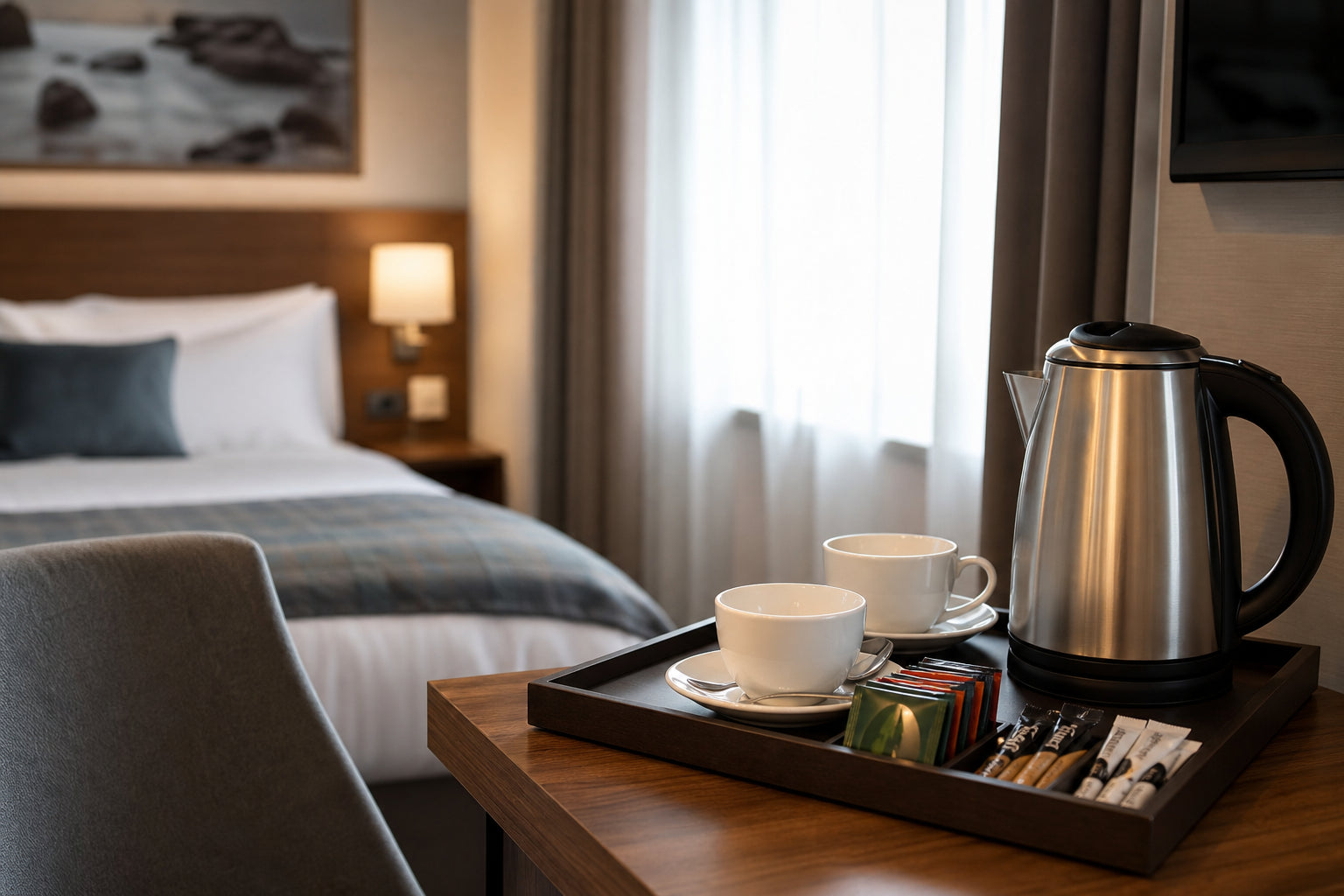
Operators who treat the kettle as an afterthought — the cheapest unit that fits the tray — often pay for it in reviews without ever connecting the dots. This guide explains why the humble kettle carries so much weight, how it influences breakfast and room-quality scores, and how to specify a hospitality tray that meets brand standards and holds up across a busy estate.
The first cup: why the kettle sets the tone
First impressions in a guest room are cumulative. The guest takes in the lighting, the bed, the bathroom — and then they test something. The kettle is frequently that test, because it is the one appliance almost every guest uses on almost every stay, often within the first ten minutes of arrival.
That makes the kettle a disproportionately powerful signal of quality. A kettle that boils quickly, sits securely on its base and pours cleanly tells the guest, without a word, that the room has been thought through. A kettle that is scaled up inside, wobbles on a worn base, or takes an age to boil sends the opposite message — and it colours everything that follows. Guests rarely separate the appliance from the room; a poor kettle becomes "a tired room," even when everything else is in good order.
The interaction is also emotional in a way few other amenities are. Arriving tired after a long journey, a guest wants that first hot drink to be easy. Deliver it well and you have started the stay on a note of comfort and competence. Get it wrong and the guest's very first impression is one of mild frustration.
How the kettle shapes breakfast reviews
It may seem odd that an in-room kettle influences breakfast scores, but the link is real and worth understanding. Many guests — early risers, business travellers, families getting children ready — take their first drink of the day in the room before they ever reach the restaurant. That in-room brew becomes part of their breakfast experience whether or not the dining room realises it.
When that first cup goes badly, the disappointment carries downstairs:
- A slow kettle means a guest heading to an early meeting without a proper drink — and a grumble about "not being able to get a decent cup."
- A limescale-clogged kettle produces cloudy, off-tasting water that guests notice immediately and remember.
- An empty or poorly stocked tray leaves the guest without milk, sugar or a clean cup, turning a simple ritual into a call to reception.
These frustrations frequently surface in reviews under "breakfast" or "food and drink," because that is how the guest mentally files anything to do with tea, coffee and their morning routine. A strong in-room tray quietly protects the breakfast score; a weak one drags it down before the kitchen has even opened.
The kettle as a perceived-quality signal
Guests use small, tangible details to infer the overall standard of a hotel. They cannot inspect the boiler, the mattress core or the water system, so they judge quality by proxy — and the kettle and its tray are among the most-handled proxies in the room.
Several details do the signalling:
- Boil speed and quietness. A fast, controlled boil feels premium; a slow, rattling one feels cheap.
- Cleanliness and condition. A descaled interior and an unmarked exterior say the room is genuinely maintained, not just tidied.
- Stability and safety. A kettle that seats firmly on its base and has a well-fitted lid reassures the guest, particularly families.
- Presentation of the tray. Matched cups, a clean tray and neatly arranged accompaniments read as care and consistency.
None of these details is expensive on its own, but together they carry a message about how the whole property is run. This is precisely why the kettle belongs in the brand standard rather than in the "buy whatever fits" category — it is one of the cheapest ways to signal quality, and one of the cheapest to get wrong.
Building the hospitality tray to a brand standard
The kettle rarely works alone. It anchors a hospitality tray, and the tray as a whole is what the guest experiences. Specifying it to a consistent standard across your estate protects both the guest experience and your operational efficiency.
A well-considered hospitality tray typically includes:
- A reliable cordless kettle sized to the room — smaller for singles and doubles, larger where guests travel in groups.
- Cups or mugs that match the property's tier, with saucers where the brand standard calls for them.
- A clean, wipeable tray that contains everything and makes housekeeping's job quick and repeatable.
- Clearly presented tea, coffee, sugar and a fresh milk solution appropriate to the property.
- Teaspoons, and a discreet place for used items so the setup stays tidy through the stay.
Consistency is the goal. When every room is set up the same way, housekeeping can replenish quickly and accurately, guests get the same experience whichever room they are given, and standards are far easier to audit. You can build a coherent tray from our guest-room amenity collections, matching kettle format and finish to the rest of the in-room offering.
Maintenance, longevity and total cost
The cheapest kettle on the shelf is rarely the cheapest over its life. In a hotel, a kettle is used far harder than in a home, often several times a day, every day. Durability, ease of descaling and reliable performance under heavy use are what actually determine cost over time.
Operators can protect both budget and guest experience with a few practical habits:
- Descale on a schedule. UK water is frequently hard, and limescale is the single biggest enemy of kettle performance, taste and lifespan. Build descaling into the housekeeping or maintenance routine rather than waiting for complaints.
- Specify for the environment. Choose kettles built for repeated commercial-style use rather than occasional domestic use.
- Standardise models. A consistent kettle across the estate simplifies spares, training and replacement, and keeps every room to the same standard.
- Inspect during turnover. A quick check of base, lid and interior at each clean catches wear before a guest does.
Viewed this way, the kettle is not a disposable commodity but a small, hard-working piece of equipment whose reliability is felt on every stay. Specifying and maintaining it well costs little and pays back in fewer complaints, steadier scores and a longer service life.
A small amenity with outsized influence
Few items in a guest room deliver as much return on attention as the kettle. It is used by almost every guest, it shapes the first impression, it feeds into breakfast and room-quality scores, and it signals the overall standard of the property — all at a modest cost. Treating it as a genuine brand-standard amenity, rather than a line to be squeezed, is one of the simplest ways to lift the everyday guest experience across an estate.
Quick answer: Guests judge a room the moment they make their first cup of tea. Here is why the in-room kettle is a brand-standard amenity that shapes breakfast reviews and perceived room quality.
Benefits
- Gives every guest an immediate comfort ritual on arrival.
- Reduces early-morning room service pressure for hot drinks.
- Supports brand consistency when trays and cups match estate-wide.
- Protects reviews when boil speed and cleanliness are reliable.
Features
- Fast-boil hotel kettles sized for guest-room use.
- Matched hospitality trays with cups and refreshment space.
- Durable finishes suited to daily housekeeping handling.
- Easy-descale designs that keep presentation inspection-ready.
Frequently asked questions
Should every guest room have a kettle?
For most UK hotels, yes — a working kettle tray is now a baseline amenity guests notice when missing.
What makes a hotel kettle different from a domestic kettle?
Hotel models are built for frequent use, safer tray placement, and consistent presentation across many rooms.
How often should kettle trays be refreshed?
Daily as part of room cleaning — water emptied, cups reset, and limescale managed on a planned cycle.
Can a poor kettle affect guest scores?
Yes. Slow boil, stained cups or missing supplies appear often in mid-scale reviews.
For operators reviewing in-room standards for the year ahead, the hospitality tray deserves the same care as any headline feature of the room. Get the small ritual right and guests barely notice it — which is exactly the point.
Roomwell supplies kettles and complete hospitality-tray amenities to hotels across the UK, chosen for reliability and consistent presentation. Browse the range in our guest-room amenity collections, or contact our team to specify a hospitality tray that meets your brand standard across every room.