

Safety and security are the quietest parts of a guest room. When they are done well, guests never think about them: the door closes with a reassuring weight, the safe works first time, the kettle boils without drama and the corridor feels calm. When they are done badly, they dominate the stay — and the review. A latch that does not engage, a hair dryer with a frayed cable or a safe that will not open at checkout can undo months of good service in a single sentence.
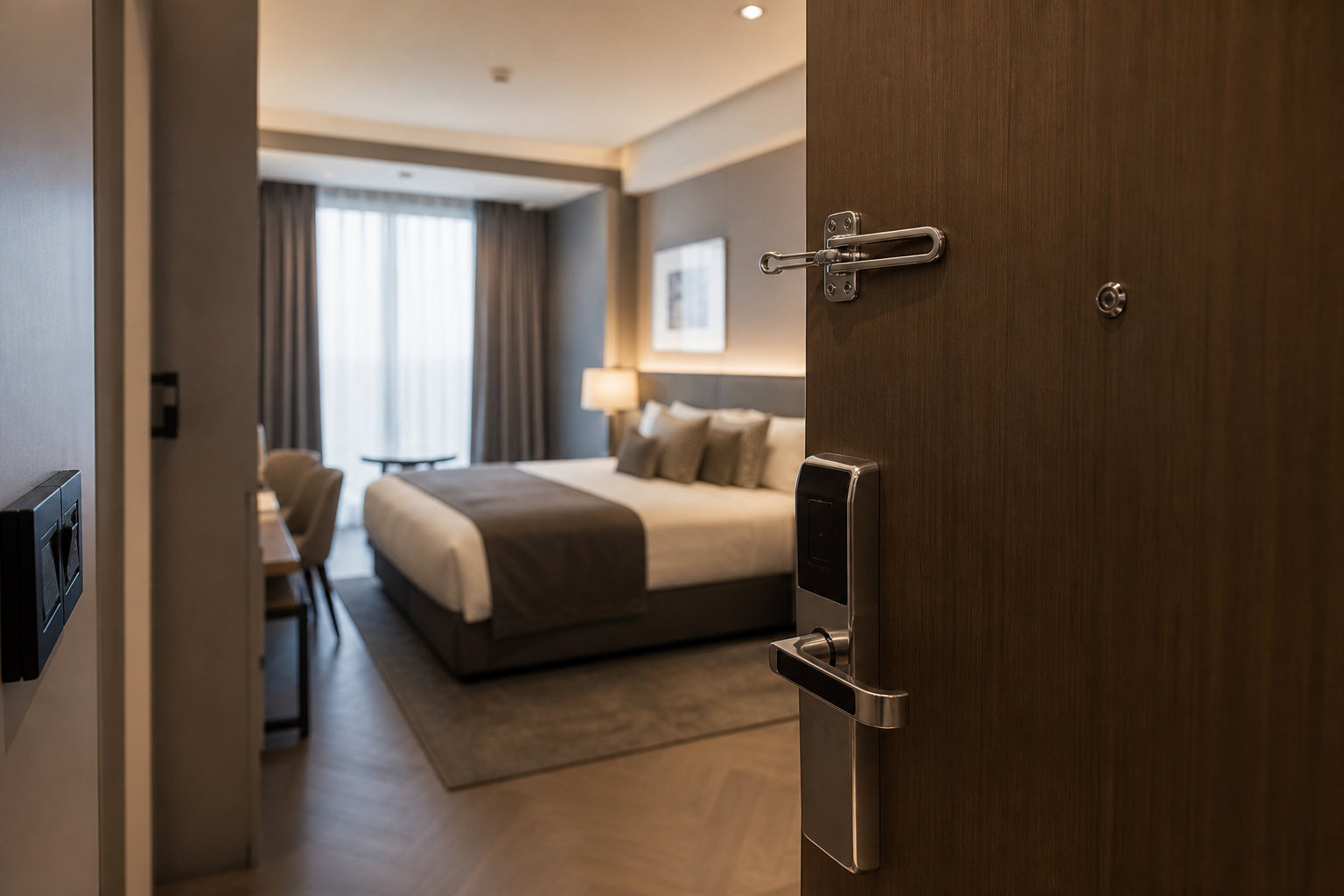
The good news for operators is that most guest room safety and security is not exotic. It is a set of practical standards — hardware that works, appliances that are checked, procedures that staff actually follow — applied consistently across every room. This guide walks through the areas that matter at operator level, from the door inwards, and finishes with a checklist you can adapt to your own property.
The door: hardware, viewers and the feeling of security
A guest's sense of security starts at the door, and it is judged by feel as much as function. A door that swings shut under its own weight and latches positively tells the guest the room is secure. One that has to be pulled hard, or that bounces off a worn strike plate, plants a small seed of doubt that colours the whole stay.
At a practical level, the door standard for each room should cover:
- Self-closing and positive latching. The door should close and latch on its own from any normal opening angle. Doors that need a shove are doors that get left ajar.
- A secondary security fixing. A swing bar or security latch gives guests a way to secure the room from inside while still being able to open the door partially. It should operate smoothly and be mounted at a sensible height.
- A working door viewer. The peephole is a simple, inexpensive fitting that lets a guest check who is at the door before opening it. It should be clear, unobstructed and fitted with a privacy cover where the brand standard calls for one.
- Sound condition throughout. Hinges, frames, seals and thresholds all age. A quick check at deep clean or maintenance rounds catches loose screws and worn closers before a guest does.
None of this is glamorous, but it is the hardware guests touch every time they enter and leave. It deserves the same inspection discipline as anything else in the room.
In-room safes and looking after guest valuables
Guests travel with laptops, passports, medication and jewellery, and they want somewhere sensible to put them. A working in-room safe answers that need quietly; the absence of one — or a safe that fails — pushes the problem to reception and into the review.
A practical safe standard looks like this:
- Sized for real luggage. A safe that cannot hold a laptop is a safe that will not be used. Specify for the items guests actually carry.
- Properly fixed. Safes should be secured to the fabric of the room or a fitted wardrobe, not sitting loose on a shelf.
- Reset at every turnover. Housekeeping should confirm the safe is open, empty and cleared of the previous guest's code as part of the room check.
- A controlled override procedure. When a guest forgets a code, the master release should be handled by named, trained staff with the guest present and the event logged. An override that anyone at the desk can perform is not a security feature.
- Consistent guidance. A short, clear instruction card beats a call to reception at 11pm.
It also helps to standardise the model across the estate, so training, spares and battery replacement are the same in every room. Roomwell supplies electronic in-room safes alongside its guest-room appliance range — you can view the current line in the Roomwell products collection.
For items larger or more valuable than the room safe can sensibly hold, the property should have a clear front-desk deposit procedure, and staff should know how to explain it rather than improvising.
Electrical safety: kettles, hair dryers and irons
The guest room contains a small fleet of portable appliances — kettle, hair dryer, iron, sometimes a minibar and more — and each one is handled daily by people who have never read its manual. Electrical safety here is mostly about condition, inspection and sensible placement.
- Inspect cables and plugs at turnover. Frayed flexes, cracked plugs, scorch marks and loose kettle bases are all visible in seconds. Housekeeping should know what to look for and how to report it, and a faulty appliance should be swapped out immediately rather than left "for maintenance to look at".
- Test on a schedule. Most operators build routine portable appliance inspection and testing into their maintenance calendar. Whatever regime your property follows, the important operational points are that it is documented, dated and actually covers every room.
- Specify for hard use. Domestic appliances used commercially wear out fast. Kettles, hair dryers and irons built for hospitality use survive daily handling far better, which is itself a safety benefit — worn equipment is where problems start.
- Place appliances sensibly. Kettles belong on a stable tray away from the bed and away from where a trailing flex crosses a walkway. Irons need a board and a heat-safe resting point; hair dryers should be positioned away from water.
- Standardise and record. One kettle model, one dryer model, one iron model across the estate makes inspection faster and replacement unambiguous.
Because appliances are replaced piecemeal over years, estates drift into a mix of models and ages. An annual room-by-room appliance audit — what is in the room, how old it is, when it was last checked — is a half-day job that removes most of the guesswork.
Fire awareness and bathroom safety
Fire safety in hotels is governed by formal requirements that sit with the responsible person for the premises, and nothing in a blog post replaces professional fire risk assessment. At room level, however, there are practical habits that support whatever regime your property operates:
- Keep escape-route information in the room current, legible and correctly positioned for that specific room — not a generic plan left over from a refurbishment.
- Make sure housekeeping knows that self-closing fire doors must never be wedged open, including during servicing.
- Treat anything heat-producing — irons, hair dryers, kettles — as part of the fire picture: check condition, provide safe resting surfaces and remove damaged units from service straight away.
- Report cluttered corridors, propped doors and missing signage through a route staff actually use, and act on those reports quickly.
The bathroom carries its own everyday risks, mostly around water and hard surfaces. Practical standards include slip-resistant mats or surfaces where floors get wet, secure grab points where the property provides them, well-maintained bath and shower screens, good lighting over the basin and shower, and hot water at temperatures that are comfortable without scalding. Housekeeping should flag loose fittings, cracked sanitaryware and failed sealant as safety items, not cosmetic ones.
Privacy, keycards and CCTV boundaries
Security is not only about intrusion; it is also about privacy — the guest's confidence that their room is theirs alone for the duration of the stay.
At operator level, keycard and access discipline covers a few essentials:
- Verify before issuing. Replacement keys are a classic weak point. Staff should confirm identity before cutting a new card, politely and every time, rather than handing keys to anyone who states a room number.
- Never announce room numbers aloud. Write the number on the key wallet and hand it over; do not broadcast it across the lobby.
- Control master and sub-master cards. Know how many exist, who holds them on each shift, and what happens when one is lost. A lost master card should trigger an immediate, defined response.
- Expire access cleanly. Cards should stop working at checkout, and contractor or staff access to rooms should be traceable to a person and a time.
- Respect the door signage. A "do not disturb" indicator should genuinely control entry, with a clear escalation procedure for welfare checks when a room has not been serviced for an extended period.
CCTV needs an equally clear boundary. Cameras belong in public and back-of-house areas — entrances, corridors, car parks, lifts, service areas — where they support guest and staff safety. They never belong inside guest rooms or bathrooms, and the property should be able to say plainly where cameras operate, who can view footage and how long it is kept. Guests increasingly ask; a confident, accurate answer is itself a trust signal.
Staff procedures: the standard behind the standard
Hardware and appliances only deliver safety if the people servicing the rooms use them properly. The procedural layer is what turns good specification into a consistent guest experience:
- Entry protocol. Knock, announce, wait, and knock again before entering — every time, even when the room is believed vacant. Prop the door per your service standard and never leave a master card in an open door.
- Turnover checks. Build safety points into the housekeeping checklist: door closer and latch, security latch and viewer, safe open and reset, appliance cables and plugs, bathroom fittings, escape-route notice present.
- Fault reporting that works. A safety fault should be quick to report and visible until resolved. If reporting is slower than ignoring, staff will ignore.
- Lost property and found valuables. Log items found in rooms, store them securely and follow a defined return procedure. It protects guests and staff alike.
- Refreshed training. Short, regular refreshers — what to check, what to say to guests, when to escalate — keep the standard alive as teams change.
The pattern across all of this is the same: nothing here requires major capital spend. It requires clear specification, consistent checks and equipment chosen for the job. A room where the door hardware works, the safe resets reliably, the appliances are sound and the staff follow the same routine in every corridor is a room where guests feel safe without ever thinking about it — which is exactly the goal.
Quick answer: Guests rarely mention safety in reviews — until something feels wrong. Here is a practical, operator-level guide to guest room safety and security, from door hardware and safes to appliance checks and staff procedures.
Benefits
- Helps hotels and travellers act on: Guests rarely mention safety in reviews — until something feels wrong. Here is a practical, operator-level guide to guest room safety and security, from door hardware and safes to appliance checks and staff procedures.
- Turns vague hospitality advice into practical room-level decisions.
- Supports better guest satisfaction through clearer standards.
- Connects room presentation, appliances and operations in one framework.
Features
- Operator-focused guidance for UK hospitality rooms.
- Clear standards guests can feel on arrival.
- Checklist-style points teams can train against.
- Links between guest comfort and equipment reliability.
Frequently asked questions
What is the key takeaway from “Guest Room Safety and Security: Practical Standards for Hotels”?
Guests rarely mention safety in reviews — until something feels wrong. Here is a practical, operator-level guide to guest room safety and security, from door hardware and safes to appliance checks and staff procedures.
Why do in-room details matter so much?
Because guests judge the whole hotel through sleep, bathroom cleanliness and whether everyday appliances work.
How should hotels prioritise upgrades?
Fix foundations first — bed, bathroom, noise and reliable appliances — before decorative extras.
Where can operators find suitable guest-room equipment?
Browse Roomwell’s hospitality collections or contact the team for specification support.
Roomwell supplies electronic safes, kettles, hair dryers, irons and other guest-room appliances built for daily hospitality use to hotels across the UK. Browse the range in the Roomwell products collection, or contact our team to specify safes and appliances that support a consistent safety standard across every room.