

Ask ten hoteliers what "clean" means and you will get ten similar answers. Ask what "brand-ready" means and the answers start to diverge — yet brand-ready is the standard guests actually judge. A room can be technically clean and still fail the guest: a kettle furred with limescale, a wardrobe door that drops on its hinge, a faint odour the last deep clean did not shift, a hair dryer that cuts out halfway through use. None of these is a housekeeping failure in the narrow sense, but every one of them tells the guest the room is tired.
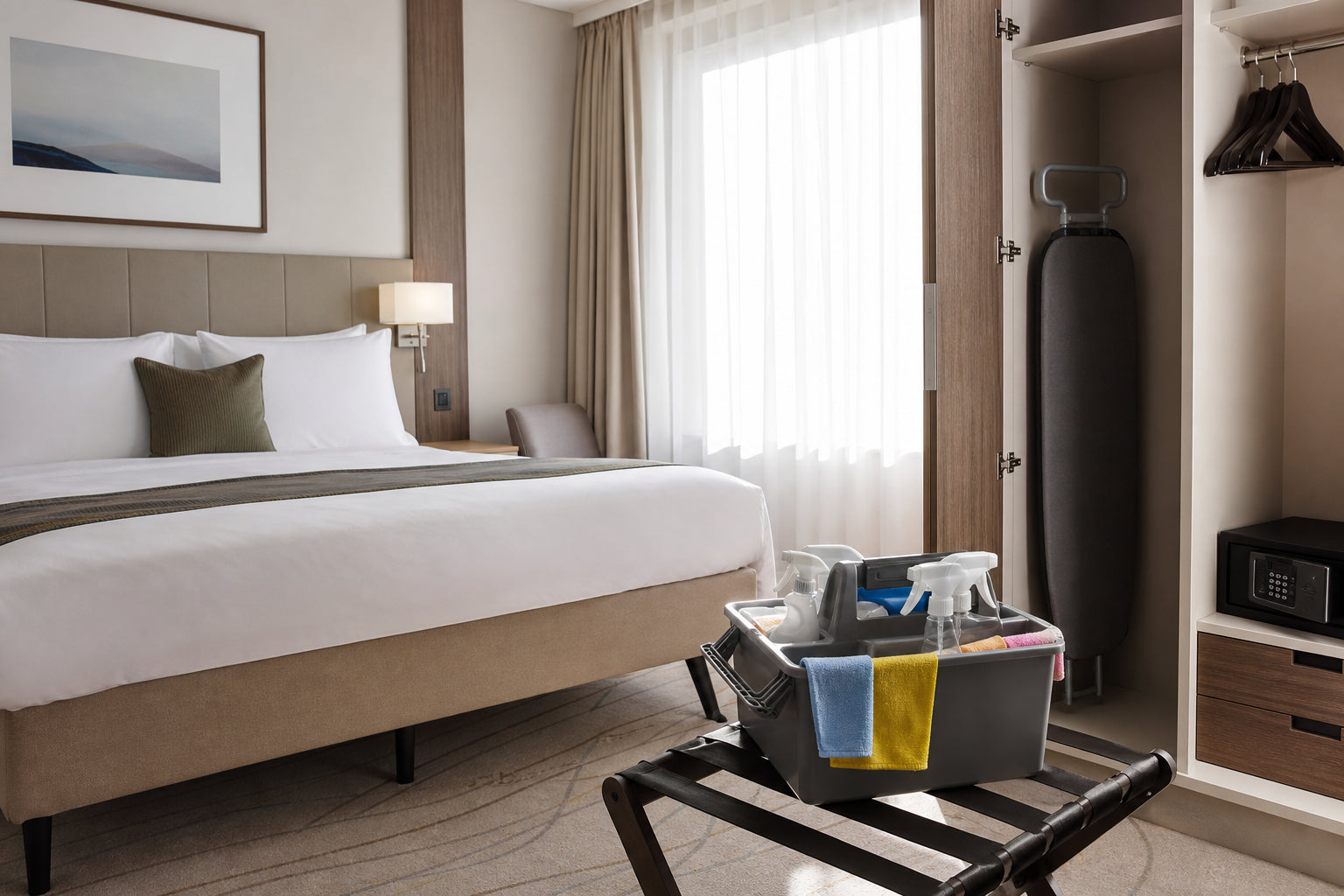
Keeping rooms brand-ready is not a single discipline. It is the sum of four: a reliable daily clean, a scheduled deep clean, planned maintenance for the furniture, fixtures and appliances that guests handle every day, and a defect-reporting culture that catches problems before guests do. This guide sets out how the four fit together, and where operators most often lose ground without realising it.
What "brand-ready" actually means
Brand-ready is a more demanding test than clean. A brand-ready room is one you would be happy to walk any guest into, at any moment, without apology or explanation. It means the room is clean, everything in it works first time, everything is where the standard says it should be, and nothing in the room contradicts the impression the brand is trying to make.
The distinction matters because guests judge rooms holistically. They do not separate "housekeeping did their job" from "maintenance has not been in yet." A perfectly made bed next to a scuffed skirting board reads as a tired room, full stop. Defining brand-ready explicitly — in writing, room type by room type — gives every department the same target:
- Surfaces and textiles clean to a defined standard, with no visible staining, dust or marks.
- Appliances — kettle, hair dryer, safe, minibar, iron — present, clean, working and correctly positioned.
- FF&E free of damage a guest would notice: no chipped veneer, loose handles, sagging drawers or marked upholstery.
- Presentation to standard: tray set consistently, ironing board and bin in their agreed places, nothing missing and nothing extra.
- No odours beyond fresh linen and clean air.
Once brand-ready is written down, it becomes auditable. Supervisors can check rooms against a standard rather than an opinion, and the phrase "good enough" quietly disappears from the vocabulary.
Daily cleaning versus deep cleaning: two jobs, not one
The daily clean and the deep clean solve different problems, and treating them as interchangeable is one of the most common ways rooms drift below standard. The daily clean resets the room for the next guest: linen changed or refreshed, bathroom sanitised, surfaces wiped, bins emptied, amenities replenished, presentation restored. It is fast, repeatable and focused on what the incoming guest will see and touch.
The deep clean deals with everything the daily clean cannot reach in the time available. On a rota — commonly aligned to occupancy patterns so rooms come out of service when it hurts least — each room gets systematic attention:
- Mattresses turned or rotated per the manufacturer's guidance, protectors laundered, bed bases and headboards vacuumed and inspected.
- Curtains, sheers and soft furnishings cleaned or sent out; carpets shampooed or extracted rather than just vacuumed.
- Furniture pulled out and cleaned behind; high-level dusting of light fittings, air vents and wardrobe tops.
- Appliances cleaned properly: kettles descaled, hair dryer filters cleared of lint, minibar interiors washed and door seals wiped, safe interiors and keypads cleaned.
- Grout, sealant and extractor fans in the bathroom given the attention a fifteen-minute service clean never allows.
The operational point is simple: if the deep-clean rota slips, no amount of excellent daily cleaning will hold the standard, because the problems accumulating are ones the daily clean was never designed to solve. Protect the rota the way you would protect a maintenance contract.
Planned maintenance for FF&E and in-room appliances
Guest rooms are hard environments. A domestic kettle at home boils a few times a day; a hotel kettle can boil that many times before breakfast. Wardrobe doors, drawer runners, ironing board hinges, luggage racks and desk chairs all take a level of use their domestic equivalents never see. Waiting for these items to fail — which usually means waiting for a guest to find the failure — is the most expensive way to manage them.
Planned, preventative maintenance (PM) turns that around. The principle is to inspect and service on a schedule, so that wear is caught in the corridor rather than in a review. A workable PM approach for guest rooms includes:
- A room-by-room asset list. Know what is in each room — appliance models, furniture items, install dates — so servicing and replacement can be planned rather than improvised.
- Scheduled appliance checks. Kettles inspected and descaled on a cycle suited to local water hardness; hair dryers checked for airflow, cable condition and secure wall mounts; safes tested for battery level and locking function; minibars checked for temperature, door seal and condensation; irons and boards checked for soleplate condition and frame stability.
- Electrical safety testing for portable appliances carried out to the property's compliance regime, recorded and traceable per room.
- FF&E rounds. Hinges, runners, handles, castors and fixings tightened and lubricated on a rota; upholstery and headboards inspected for wear before it becomes visible damage.
- Standardisation. The fewer appliance models across the estate, the simpler spares, training and like-for-like replacement become. Specifying consistent, hospitality-grade equipment — such as the guest room ranges in the Roomwell products collection — makes the PM programme dramatically easier to run.
PM also changes the economics. Appliances that are descaled, cleaned and checked last longer and fail less often, which means fewer emergency call-outs, fewer rooms out of service at short notice, and a replacement budget that can be planned a year ahead instead of raided a week at a time.
Stains and odours: the standards killers
Nothing undoes a room faster than a stain or a smell. Both carry a significance to guests far beyond their size, because both suggest the room's history — and guests do not want to think about the room's history. They are also the two problems most likely to be "worked around" by busy teams, which is how a marked chair cushion ends up turned over rather than cleaned, and how a musty smell gets a burst of air freshener instead of a cause.
The operational answer is speed and honesty:
- Treat stains immediately. Almost every textile stain is easier to remove in the first hour than the first week. Housekeeping should have the products, training and authority to treat on the spot, and a clear escalation route to professional cleaning for anything beyond in-house capability.
- Trace odours to source. Persistent smells have causes — damp behind furniture, a failing extractor, drink spills deep in carpet underlay, a minibar seal harbouring residue, smoking contrary to policy. Masking the smell leaves the cause in place and adds a layer of fragrance guests read, correctly, as concealment.
- Take the room out of service when needed. A room sold with an unresolved stain or odour trades a night's revenue for a public review. That is a poor exchange. Build the confidence — and the authority at supervisor level — to pull a room until it is genuinely right.
- Protect at the specification stage. Wipeable surfaces, removable and washable covers, sealed flooring in wet areas and bins with lids and liners all reduce the frequency and severity of both problems before housekeeping ever gets involved.
Defect reporting: the system that holds it all together
Housekeepers see every room, every day. They are the property's early-warning system — but only if what they see reliably turns into a logged, tracked, closed-out job. In many properties the gap between "housekeeping noticed it" and "maintenance fixed it" is where brand-readiness quietly dies.
A defect-reporting system that works has a few consistent features:
- Reporting is effortless. Whether it is an app, a ticketing system or a structured paper form, logging a defect must take seconds and be possible from inside the room. Friction is the enemy; every extra step loses reports.
- Everything is logged, however small. A slow-draining basin, a flickering lamp, a kettle lid that no longer seats properly — small defects are tomorrow's guest complaints. A culture of "log it anyway" beats a culture of "only report real problems."
- Every report gets a status. Open, in progress, done — visible to the person who reported it. Nothing kills a reporting culture faster than reports vanishing into silence. When housekeepers see their reports actioned, they keep reporting.
- Defects block the room where they should. The system needs a clear line between "fix on next PM round" and "do not sell this room tonight," and supervisors need the authority to draw it.
- Patterns get reviewed. Recurring defects are specification information. If the same drawer runner fails across twenty rooms, the answer is a better runner, not twenty repairs. Defect data should feed directly into purchasing decisions and FF&E replacement plans.
Reviewed this way, defect reporting is not paperwork — it is the feedback loop that connects daily cleaning, deep cleaning and planned maintenance into one system with a shared standard.
A brand-ready room, every time
No single department keeps a room brand-ready. The daily clean resets it, the deep clean restores it, planned maintenance keeps its contents working, and defect reporting catches what all three miss. Take any one of the four away and the others cannot compensate for long. Put them together — with a written definition of brand-ready that everyone works to — and the standard stops depending on individual heroics and starts being the ordinary output of the system.
The specification stage is where much of this is won or lost. Durable, serviceable, standardised in-room equipment makes every cycle above easier: easier to clean, easier to maintain, easier to replace like-for-like. Roomwell supplies hospitality-grade guest room appliances and equipment to hotels across the UK — kettles, hair dryers, safes, minibars, ironing equipment and bins built for daily commercial use. Browse the Roomwell products collection, or contact our sales team to specify in-room equipment that helps keep every room brand-ready.
Quick answer: A room is either brand-ready or it is not — guests do not grade on effort. Here is how daily cleaning, deep cleans, planned maintenance and honest defect reporting work together to keep every room saleable to standard.
Benefits
- Consistent cleaning standards protect brand reputation.
- Clear checklists reduce missed amenities and rework.
- Faster room turns improve occupancy flexibility.
- Inspection discipline catches appliance and safety issues early.
Features
- Room-ready checklists covering bathroom, bed, tray and appliances.
- Standards for VIP vs standard resets.
- Maintenance escalation paths for broken kit.
- Training cues that keep every room on-brand.
Frequently asked questions
What should a guest-room inspection always include?
Bathroom spotlessness, bed presentation, hospitality tray, working appliances, safe reset and overall odour/noise readiness.
How do hotels keep standards consistent across staff?
Written checklists, sample rooms, and random inspections — not memory alone.
Why do missing amenities keep recurring?
Usually reset discipline, not purchasing. Standard kits and clear wardrobe layouts help.
Should VIP rooms use a different checklist?
Yes — same foundations plus welcome readiness, preferences and higher presentation detail.