

Guests describe 5-star comfort in passive terms — "so relaxing," "slept like a log," "didn't want to leave the room" — as though comfort were an atmosphere the hotel happens to possess. Operators at that level know better. Comfort is the most deliberately engineered product in the building: specified sense by sense, tested item by item, and defended nightly against everything that erodes it.
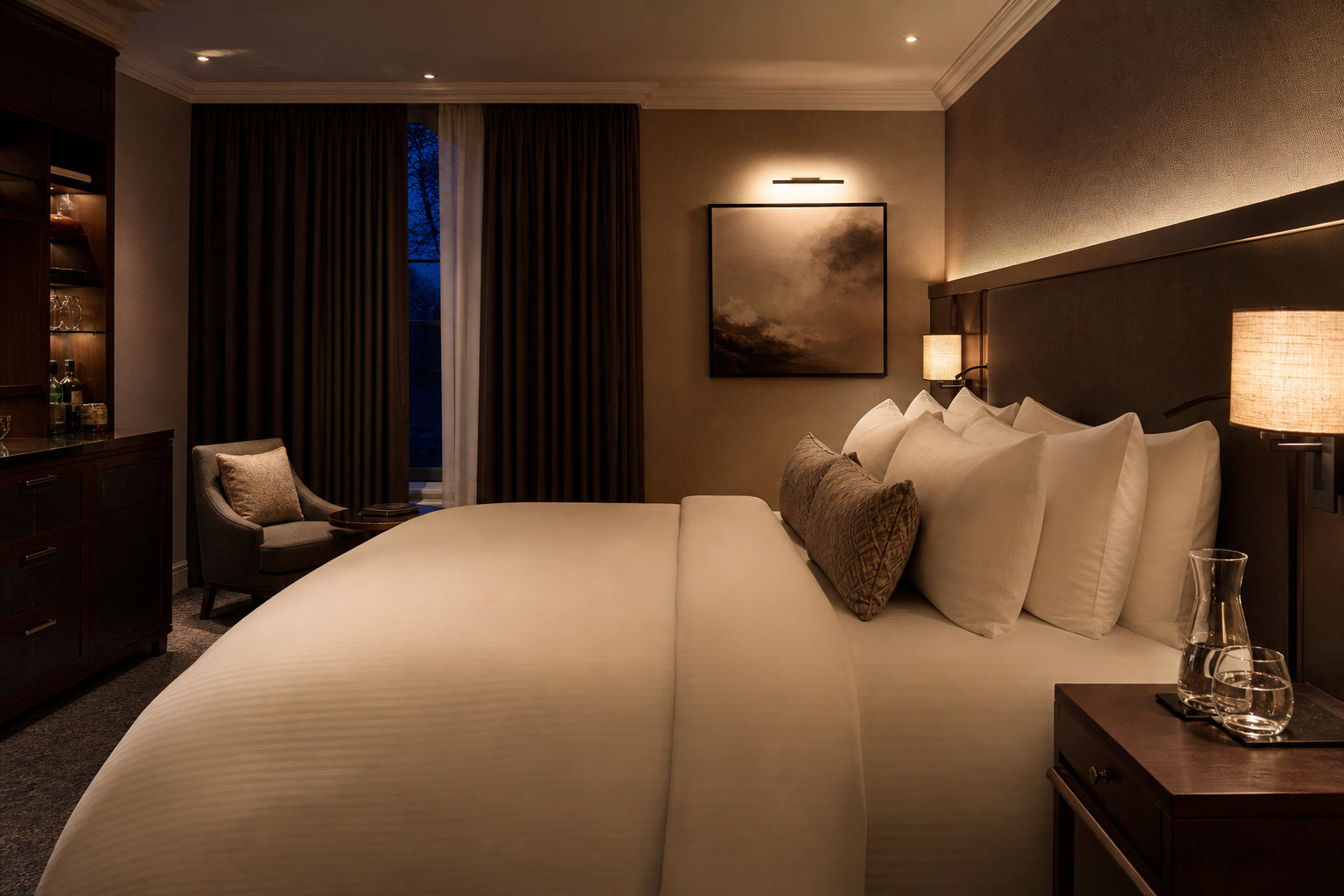
This article takes comfort apart the way the top tier builds it — sleep, climate, sound, bathing, and the accumulation of small conveniences — and draws out the methods that transfer to hotels at every level of the market.
Sleep: the core deliverable
Everything in a 5-star room ultimately answers to one metric: how well the guest sleeps. The bed is the visible centrepiece — a premium mattress, mattress topper, layered duvets and a genuine choice of pillows — but the engineering extends well beyond it.
Darkness is treated as a specification, not a hope: blackout curtains or blinds that actually seal at the edges, and a room audit for stray LEDs — standby lights on televisions, glowing switches, charger indicators — each one masked or specified out, because at 3 a.m. a single blue diode is a searchlight.
Pre-sleep ritual is supported too: turndown service that dims the room and resets it for night, water at the bedside, and controls reachable without getting up. The guest experiences all of this as "I slept wonderfully"; the property experiences it as a checklist held every single night.
Silence: comfort's invisible half
If sleep is the deliverable, silence is its principal ingredient — and the area where 5-star properties are most ruthless about their own equipment. Every sound source in the room is interrogated. The minibar is the classic case: compressor fridges cycle audibly through the night, so the top tier specifies silent absorption minibars as standard, trading a little cooling speed for total quiet. Air conditioning is maintained before it develops a voice. Door hardware is damped so corridors do not slam. Even the wardrobe doors run on soft closers.
Beyond the room's own equipment, operational discipline protects the quiet: housekeeping trolleys timed away from sleeping hours, corridor conversations managed, maintenance work scheduled against occupancy. The lesson for any operator is that noise complaints are rarely about the neighbourhood — most of the sound a guest hears is the hotel itself, which means most of it is specifiable away.
Climate: control given to the guest
Thermal comfort at the top tier rests on one principle: the guest, not the building, decides. Room-by-room climate control that responds quickly, windows that open where the building allows, bedding layers the guest can add or shed, and extra blankets placed where they can be found without a phone call.
The nuance five-star properties understand is that thermal comfort is dynamic — guests run hot after travel, cold at dawn — so the room offers adjustment at every point: the thermostat, the bedding, the bathrobe, the fan setting. Properties with older or simpler systems can still honour the principle: responsive heating, a fan in the wardrobe, breathable layered bedding rather than a single heavy duvet.
Bathing: the second comfort centre
The bathroom is where comfort engineering is most physical. The non-negotiables at the top tier: water pressure and temperature that arrive instantly and hold steady, towels with real weight, heated rails so they are dry and warm at every use, robes and slippers as standard, and a hair dryer with genuine power — one of the most-handled comfort items in the room and one of the most complained-about when it is weak.
Lighting completes the engineering: bright and true at the mirror for function, softer overall for relaxation, and never a single harsh ceiling source doing both jobs badly. Underfloor heating and anti-mist mirrors appear as budget allows, but the hierarchy is fixed — water, towels, warmth, light — and it is the same hierarchy any property should spend down.
The accumulation of small conveniences
Beyond the big systems, 5-star comfort is compounded from dozens of minor provisions, each trivial alone:
- Power and charging at both bedsides, so no one negotiates over the single socket.
- A kettle and proper tea service for the 6 a.m. cup that starts the day gently.
- A luggage bench at the right height, so cases never open on the floor or the bed.
- Hooks where hooks are needed — behind the bathroom door, beside the wardrobe.
- A safe that fits a laptop, so the guest relaxes about the thing they worry about most.
- An iron and full-size board, so tomorrow's shirt is not a source of low-level stress.
Individually, none of these registers as luxury. Collectively, they produce the felt sense that the room has anticipated everything — which is very close to what guests mean by comfort. This layer is also the most affordable to replicate: it is a specification and procurement exercise, achievable at any tier. Operators building it can draw the equipment — kettles, safes, dryers, ironing sets and accessories — from the Roomwell products collection.
Consistency: comfort you can rely on
The final ingredient is psychological. Comfort requires the guest to stop monitoring the room — and guests only stop monitoring what they trust. A returning guest who found the bed perfect and the room silent last time relaxes on arrival this time; that pre-emptive relaxation is itself part of the product. It is produced by consistency: identical standards, identical equipment and identical execution across every room and every stay.
This is why 5-star operators are so uncompromising about standardisation and inspection. A single noisy fridge or lumpy pillow does not just cost one night's comfort; it reinstates the guest's vigilance, and vigilance is the opposite of rest.
Applying the method
The 5-star method, reduced to its transferable core, reads like this: identify every sense the room touches; specify what each should experience; buy equipment that meets the specification quietly and reliably; hold it with maintenance and inspection; and never let a single room diverge. Budget determines how sumptuously each step is executed — but the method itself is free, and guests at every price point feel the difference it makes.
Quick answer: Five-star comfort feels effortless to the guest precisely because so much engineering sits behind it. A breakdown of how the top tier builds comfort — sense by sense — and what any hotel can apply.
Benefits
- Helps travellers match spend to how they will use the room.
- Gives operators a clearer investment map by quality level.
- Reduces expectation mismatches that drive poor reviews.
- Clarifies where appliances, bathrooms and service depth should differ.
Features
- 3-star focus: clean essentials, efficient layout, reliable kit.
- 5-star focus: space, anticipatory service, amenity choice and finish.
- Shared non-negotiables: sleep quality, bathroom cleanliness, working appliances.
- Practical decision cues for destination-led vs room-led trips.
Frequently asked questions
What is the real difference between 3-star and 5-star hotels?
3-star hotels sell essentials done well; 5-star hotels add living space, deeper staffing, richer amenities and higher finish.
Is a 3-star hotel good enough for vacation?
Yes when you prioritise location, cleanliness and sleep over suite space and anticipatory service.
Do star ratings mean the same everywhere?
No. Schemes differ by country — verify with recent reviews, not the badge alone.
Which features matter most at every star level?
Comfortable beds, spotless bathrooms, quiet nights and appliances that work first time.
Roomwell supplies UK hotels with the comfort-critical equipment layer: silent minibars, quality kettles and tea service hardware, powerful hair dryers, laptop-size safes and ironing equipment, all specified for hotel use. Browse the Roomwell range, or contact our team to engineer comfort into your rooms.