

Every hotel rate card tells a story: standard, executive, junior suite, suite. Guests read that ladder and pay real money to climb it — often a substantial premium per night. What they expect in return is not a bigger number on the door but a visibly, tangibly better room. And this is where many properties stumble: the executive room that is a standard room with a bathrobe, the "suite" that is one large room with a sofa pushed against the wall. Guests notice, reviews say so, and the premium category quietly stops selling.
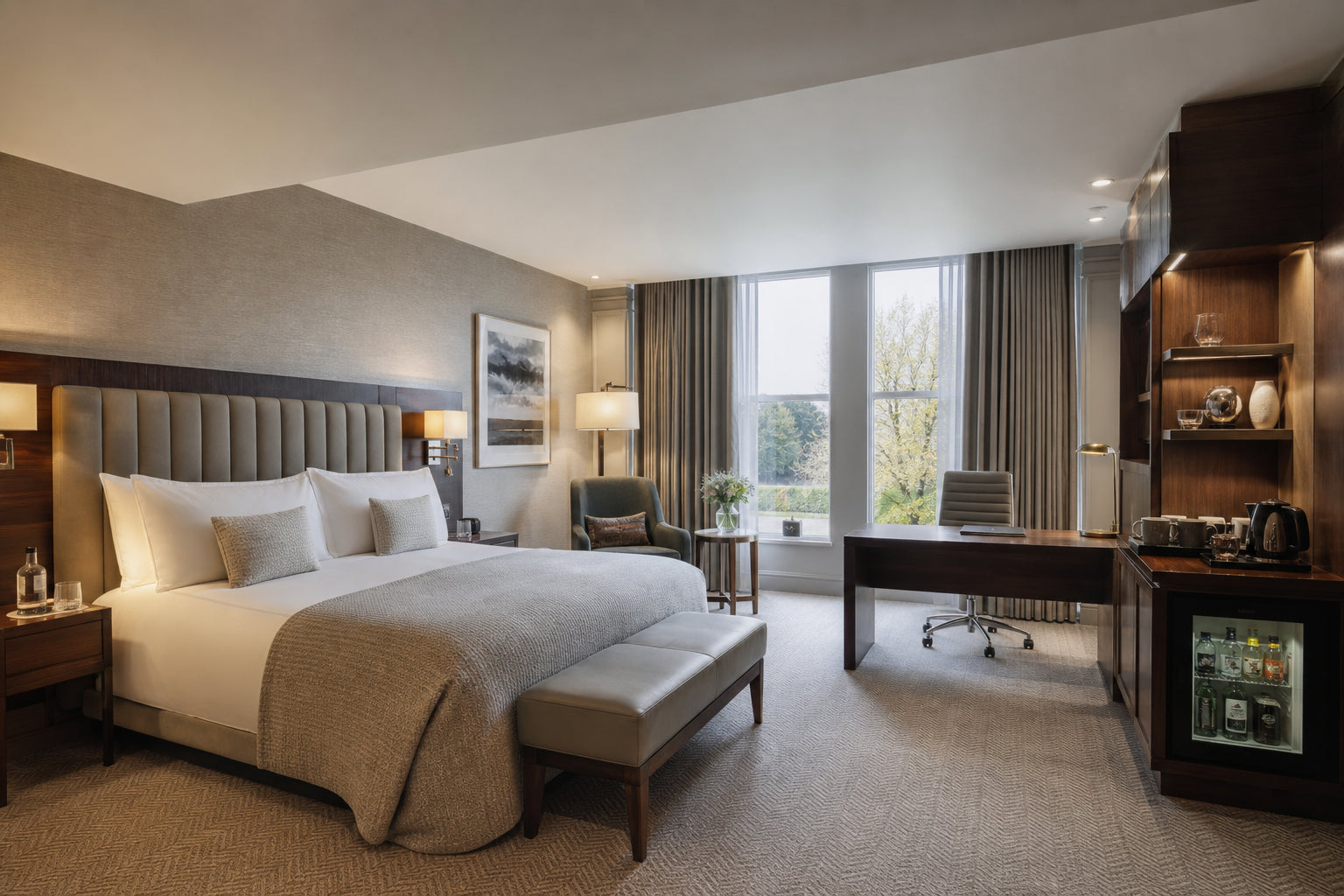
This guide sets out what genuinely defines executive rooms and suites — the space, layout, amenities and equipment that justify the rate — and gives operators a practical specification framework for making each tier honestly different from the one below. The categories only work as a ladder if every rung is real.
What "executive" should actually mean
The executive room sits one step above standard, and its historical audience — the business traveller spending working hours in the room — still shapes its logic, even as leisure guests now book it just as often for the extra comfort. A credible executive specification typically includes:
- More usable space. Not necessarily dramatically more floor area, but enough to add function: a proper armchair or small seating spot, and circulation that does not require squeezing past the bed.
- A genuine workspace. A full-size desk with a comfortable chair, good task lighting and accessible power — the difference between a room you can work in and a room with a shelf.
- An upgraded refreshment setup. This is one of the most visible tier signals: a stocked minibar (silent, if it shares the sleeping space), an enhanced hospitality tray — better coffee, a cafetière, fresh milk — and decent glassware.
- Comfort upgrades guests can feel. A better bed or bedding tier, blackout that works, robes and slippers, and upgraded bathroom amenities.
- Access benefits where the property offers them. Executive-lounge access, late checkout or a pressing service — service-side extras that reinforce the room-side upgrade.
The test is simple: could a guest stand in the doorway and see the difference from a standard room within five seconds? If the upgrade only exists in the description, it does not exist.
What makes a suite a suite
The defining feature of a true suite is separation: a living space distinct from the sleeping space, ideally with a door between them. Everything else flows from that. A suite guest can take a call, order room service or host a colleague without the bed in the frame — the room supports a private life and a semi-public one at once.
Beyond separation, established suite expectations include:
- A proper living area. Sofa, armchairs, a dining or meeting table where the format allows — furnished as a room in its own right, not as leftover space.
- Duplicated amenities. This is the specification detail most often missed. A suite needs its television, refreshment provision and often a guest WC serving the living area as well as the bedroom, so neither space depends on the other.
- An enhanced bathroom. Bath and separate shower, double vanity where space allows, and amenities a tier above the house standard.
- Room to host. Enough seating and surface area for in-room dining for more than two — suites are booked for occasions, and the room must be able to stage one.
The junior suite sits between the categories: one open-plan space with a genuinely distinct, fully furnished seating zone. It is a legitimate category — but only when the zoning is real. A sofa in a big bedroom is an executive room, whatever the rate card says.
The equipment ladder: where the tiers become tangible
Guests experience room categories through the things they touch, and the in-room equipment is where a specification ladder becomes concrete. A workable estate-wide framework:
- Minibar. Standard rooms may run a compact unit or none; executive rooms carry a stocked minibar as standard; suites carry a larger-capacity or glass-door unit staged as part of a refreshment station. In every case where the unit shares the sleeping space — which in most executive rooms it does — silent absorption cooling is the correct specification, because a premium guest paying for a better night's sleep is precisely the guest a humming compressor will lose.
- Hospitality tray. The tier shows in the details: standard tray in standard rooms; cafetière or upgraded coffee, better cups and fresh milk at executive level; a full tea-and-coffee station, sometimes with machine coffee, in suites.
- Safe. Executive and suite guests travel with laptops and valuables as a matter of course. A laptop-sized safe, simple to operate and reliably maintained, is a baseline expectation from executive level upwards.
- Garment care. Iron and full-size ironing board in-room from executive level; suites add wardrobe space that actually accommodates a week's travel, with proper hangers and luggage storage.
- Bathroom equipment. A quality hair dryer at every tier, with power and placement that make it usable at a mirror; magnifying mirrors and upgraded amenities as the categories rise.
The point of a written ladder like this is consistency: every executive room in the estate delivers the same tier, procurement can standardise models per tier, and housekeeping can audit a room against its category in minutes.
Common failure modes — and how to avoid them
The premium categories fail in predictable ways, all avoidable at specification stage:
- The invisible upgrade. The executive premium buys lounge access and nothing in the room. Guests who never use the lounge experience a standard room at an executive rate — and score it accordingly.
- The furniture-only suite. Separation without duplicated amenities. The guest in the living area still has to fetch water from the bedroom; the suite is a floor plan, not an experience.
- The tier that varies by room. Executive room 204 has the cafetière and the silent minibar; executive room 312 has neither. Inconsistency is worse than a lower standard, because it turns the category into a lottery.
- Premium room, standard maintenance. Suites often have the oldest equipment in the building because there are fewer of them and replacements are deferred. The highest-paying guests then meet the most tired kettles. Premium categories need first call on renewal budgets, not last.
An operator's audit for the premium tiers is worth running twice a year: walk each category as a guest would, check the room against its written specification, test every appliance, and confirm the five-second doorway test still passes.
Categories are promises — equip them accordingly
Executive rooms and suites are not marketing labels; they are promises priced into the rate card, kept or broken by what the guest finds behind the door. The properties that sell their premium categories well are simply the ones where the ladder is real: visible space and comfort at each step, an equipment specification written per tier, and the discipline to deliver it identically in every room of the category.
Quick answer: Guests pay a real premium for executive rooms and suites — and they arrive with expectations to match. Here is what genuinely defines each category, and how to equip rooms that justify the rate card.
Benefits
- Thoughtful amenities convert arrival into a personal welcome.
- Tiered amenities control cost while protecting VIP impact.
- In-room essentials reduce requests and friction.
- Consistent presentation supports brand photography and reviews.
Features
- Core kit: tray, dryer, safe, towels and toiletries.
- Optional VIP layers: welcome notes, local produce, upgraded consumables.
- Room-readiness checks before amenity placement.
- Allergy-aware and preference-aware delivery rules.
Frequently asked questions
What is a welcome amenity really for?
To show the guest they were expected — personalisation and timing matter more than cost.
Should every VIP get the same amenity?
No. Tier by occasion, loyalty and value so generosity stays sustainable.
What room conditions must be ready before amenities?
Clean bathroom, made bed, working appliances, chilled/clean fridge or minibar, and correct temperature/lighting.
Which amenities are now considered baseline?
Wi-Fi, kettle tray, hair dryer, towels and a clean bathroom kit in most UK hotels.
Roomwell supplies the equipment that premium room tiers are built on — silent absorption minibars, hotel kettles and hospitality setups, laptop safes, ironing equipment and hair dryers — to hotels across the UK. Browse the Roomwell product range, or contact our team to specify a category ladder your rate card can stand behind.