

Every hotel manager inherits the same deceptively simple brief: make sure every room is right, every day. The brief hides an entire discipline. Behind a room that is "right" sits a chain of decisions about standards, people, stock, equipment and checking — and a room that is wrong usually traces back to a weak link somewhere in that chain.
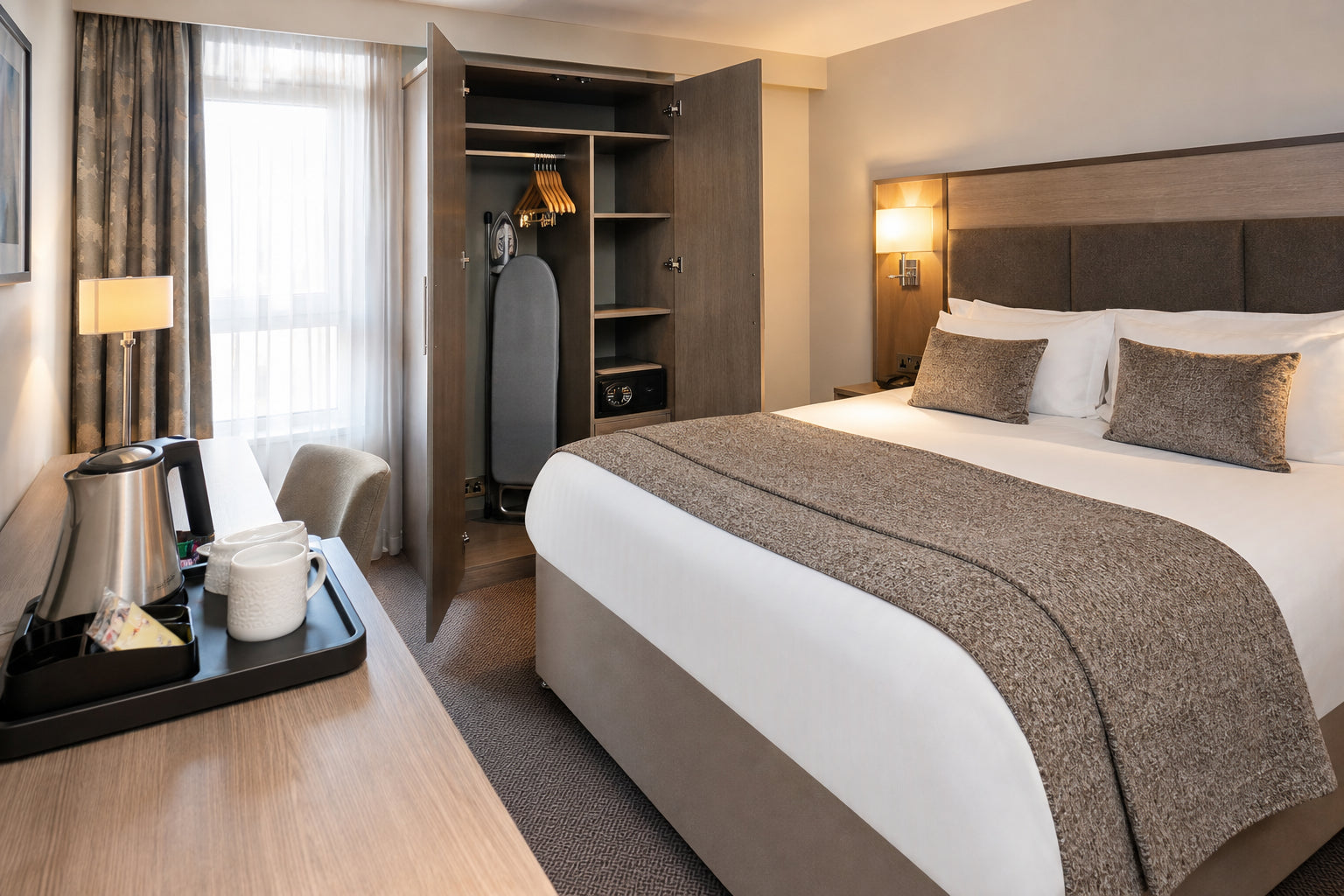
This guide sets out the essentials of guest room management as a connected system. It is aimed at operators, duty managers and heads of housekeeping who want a clear framework rather than a pile of tips — the handful of fundamentals that, done consistently, produce a consistent room product.
Essential one: a written standard for every room type
The foundation of room management is embarrassingly unglamorous: writing down exactly what each room type contains and how it is presented. Not a vague brand statement — an actual specification. How many pillows and of what type. What sits on the hospitality tray and in what arrangement. Which appliances the room carries: kettle, hair dryer, safe, minibar, iron and board. Where the spare blanket lives. What the desk looks like when the room is released.
The written standard does three jobs at once:
- It makes training concrete — a new room attendant learns against a checklist, not by shadowing whoever happens to be on shift.
- It makes inspection objective — a room either matches the specification or it does not, which removes friction between supervisors and staff.
- It makes purchasing rational — you buy what the specification calls for, in the quantities the estate needs, rather than reacting to shortages.
Properties that skip this step do not avoid having standards; they just have as many standards as they have staff members, and the guest experiences the difference room by room.
Essential two: people who know the standard and the sequence
Guest room management is delivered by people working alone in rooms, unsupervised for most of their shift. That makes training and sequence more important than in almost any other department. The manager cannot stand over every clean; the standard has to travel with the room attendant.
The practical essentials on the people side:
- Train to the sequence, not just the outcome. A fixed cleaning and restocking order — the same in every room — is what protects the standard when the shift is under pressure and rooms are being turned quickly.
- Time the work honestly. If the roster assumes twenty minutes a room and the standard genuinely takes twenty-five, the standard will lose. Either resource the time or trim the specification; do not pretend.
- Give housekeeping a voice. Room attendants see every room every day. A simple route for them to report faults, shortages and wear turns the largest team in the hotel into its best inspection system.
Essential three: stock and amenity control
Nothing undermines a room standard faster than running out of the things the standard requires. Amenity management is fundamentally a stock problem: enough linen to cover the wash cycle, enough tray consumables to survive a full house, enough toiletries on the trolley so nobody is tempted to leave a room short.
Keep it manageable with a few disciplines:
- Par levels per floor or trolley. Each trolley starts the shift stocked to a defined par based on the day's departures, not on guesswork.
- One person owns the storeroom. Consolidated ordering against the specification prevents both stockouts and the slow accumulation of mismatched products bought in a hurry.
- Count what walks. Some items — hangers, towels, hair dryers on occasion — leave with guests. Tracking loss rates by item tells you what to buy in depth and what to secure.
Essential four: equipment that is standardised and maintained
The permanent equipment in a room — kettle, minibar, safe, hair dryer, iron, TV — is where guest experience and management effort intersect most sharply. Every one of these items is used by unfamiliar hands daily, and every failure lands directly on a guest.
Two management decisions carry most of the weight here. The first is standardisation: one model of each appliance across the estate, or per tier if the property has distinct room categories. Standardisation collapses the complexity of spares, training, safety checks and replacement into something one person can actually manage. The second is specifying for hospitality use: equipment built for repeated daily operation survives hotel life; domestic-grade equipment bought on price tends to fail early, unevenly and always in front of a guest.
Around those two decisions sits a light maintenance routine: descaling kettles on a schedule appropriate to local water hardness, testing safes and checking minibar temperatures during turnover, inspecting cables and plugs, and replacing rather than repeatedly repairing items that fail twice. Operators fitting out or refreshing rooms can build a standardised set from the Roomwell products collection, which is selected specifically for consistent estate-wide use.
Essential five: inspection that closes the loop
The final essential is the one that makes the others real. Without inspection, standards drift silently; with it, drift is caught while it is still a coaching conversation rather than a guest complaint.
Inspection works best when it is proportionate and predictable:
- Check a sample, not everything. Supervisors inspecting a rotating sample of rooms per attendant per day keeps quality visible without doubling the labour of every turnover.
- Inspect against the written specification. The checklist is the standard from essential one — which is precisely why it needs to exist in writing.
- Record the reasons rooms fail. Patterns in inspection failures point at training gaps, timing pressure or stock problems far earlier than review scores do.
- Feed results back the same day. Inspection that surfaces a week later is criticism; inspection that surfaces within the shift is training.
Bringing the essentials together
Notice how the five essentials chain together. The written standard defines the work. Trained people deliver it in a repeatable sequence. Stock control ensures they have what the standard requires. Standardised, maintained equipment ensures what is in the room actually works. Inspection confirms the whole chain held, and flags where it did not.
A weakness anywhere shows up everywhere. Under-resourced timing shows up as failed inspections; ad-hoc purchasing shows up as mismatched rooms; missing specifications show up as inconsistent trays and disputed inspections. The manager's job is less about heroics on any single element and more about keeping all five links sound at once — which is why the properties that do this well make it look boring. Boring, in guest room management, is the goal.
Where to start
For an operator looking at their own property, the practical starting point is almost always the same: walk five rooms of the same type today and note the differences between them. Every difference is a decision nobody made deliberately. Write the specification those rooms should share, and the rest of the system — training, stock, equipment, inspection — has something solid to attach to.
Quick answer: Managing guest rooms well comes down to a handful of essentials done consistently: clear standards, trained people, controlled stock, reliable equipment and honest inspection. Here is how they fit together.
Benefits
- Consistent cleaning standards protect brand reputation.
- Clear checklists reduce missed amenities and rework.
- Faster room turns improve occupancy flexibility.
- Inspection discipline catches appliance and safety issues early.
Features
- Room-ready checklists covering bathroom, bed, tray and appliances.
- Standards for VIP vs standard resets.
- Maintenance escalation paths for broken kit.
- Training cues that keep every room on-brand.
Frequently asked questions
What should a guest-room inspection always include?
Bathroom spotlessness, bed presentation, hospitality tray, working appliances, safe reset and overall odour/noise readiness.
How do hotels keep standards consistent across staff?
Written checklists, sample rooms, and random inspections — not memory alone.
Why do missing amenities keep recurring?
Usually reset discipline, not purchasing. Standard kits and clear wardrobe layouts help.
Should VIP rooms use a different checklist?
Yes — same foundations plus welcome readiness, preferences and higher presentation detail.
Roomwell supplies UK hotels with the guest-room equipment side of that system: kettles, minibars, hair dryers, safes, ironing equipment and room accessories chosen for durability and estate-wide consistency. Explore the full Roomwell range, or contact our team to specify equipment against your room standard.