

Guests forgive a lot in a hotel room — a dated headboard, a small desk, a view of the car park. The bathroom is different. It is inspected within minutes of arrival, used at the most personal moments of the stay, and judged against the guest's own bathroom at home, which for many travellers has improved dramatically in the past decade. When a review mentions "tired", "grubby" or "freezing", the bathroom is very often the room being described.
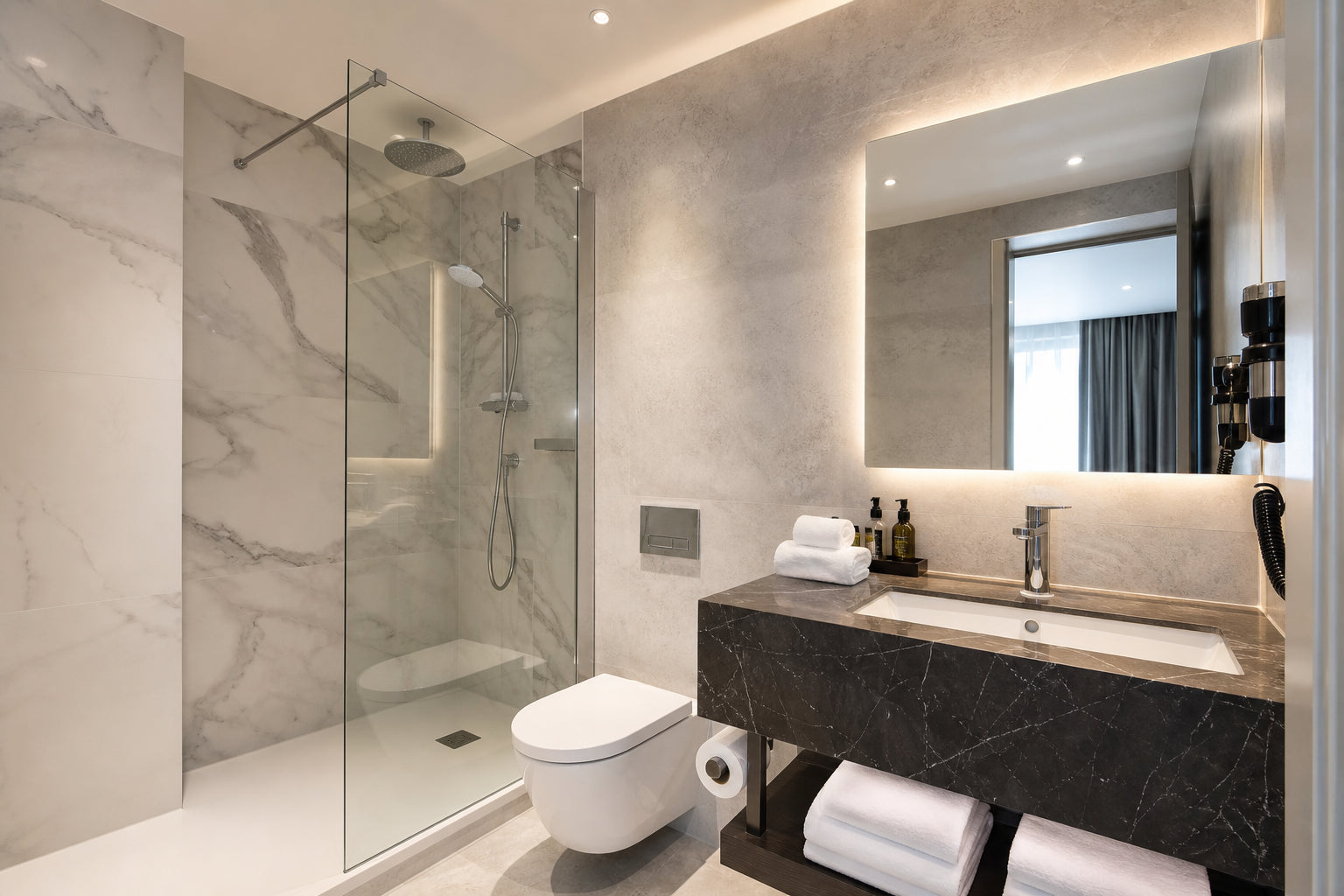
The good news for operators is that bathroom satisfaction is largely a matter of specification, not luxury. Most of what guests praise or punish comes down to a handful of practical decisions: what you install, where you put it, how it is lit and how it is maintained. This guide works through the choices that carry the most weight in reviews — from the shower-versus-bath question to the accessories that quietly make or break the daily routine.
Shower or bath: matching the fit-out to the guest
The first specification decision is the biggest one. A full bath takes space, water and cleaning time; a walk-in shower is faster to use, easier to clean and safer to step into. For most business-led and short-stay properties, a well-executed walk-in shower is the stronger choice — it is what the majority of guests actually use, and it frees floor area that makes the whole bathroom feel larger.
Baths still earn their keep in specific contexts: family rooms, leisure-led country properties, and suites where a soak is part of the offer. The mistake to avoid is the compromise that pleases no one — a cramped bath with a shower hose draped over it, a clinging curtain and a high step over the rim. If a room cannot accommodate a bath guests will genuinely enjoy, a generous shower will review better than a mediocre bath every time.
Whichever you choose, glass screens outperform curtains on both hygiene perception and housekeeping time, and a simple ledge or niche for toiletries prevents the bottles-on-the-floor look that reads as an afterthought.
Water pressure: the complaint that is really about perception
"Weak shower" is one of the most common bathroom complaints in reviews, yet it is rarely a plumbing failure alone. What guests experience as pressure is a combination of flow rate, head design and temperature stability — and two of those three can be improved without touching the water system.
- Head selection matters as much as supply. A well-designed head produces a full, even spray at modest flow rates; a scaled or poorly matched head makes even good pressure feel feeble.
- Limescale is the silent killer. In hard-water areas — much of England — blocked jets degrade the spray long before anyone reports a fault. Descaling shower heads on a routine, not on complaint, keeps the experience consistent.
- Temperature stability reads as quality. A shower that runs cold when a nearby tap opens feels cheap regardless of pressure. Thermostatic mixers are worth specifying wherever the budget allows.
Before assuming a costly system upgrade is needed, audit heads and mixers room by room. In many estates, the "pressure problem" varies wildly between identical rooms — a strong sign the issue is maintenance, not mains.
Lighting and mirrors: where guests actually get ready
Bathroom lighting is used for the most exacting tasks of the stay — shaving, make-up, contact lenses — and yet it is often specified last, as a single ceiling fitting that leaves the guest's face in shadow at the mirror. Guests may not name the lighting in a review, but it shapes whether the bathroom feels "lovely" or "dingy".
The principles are straightforward:
- Light the face, not just the room. Illumination at or around the mirror — backlit mirrors or fittings either side — removes the shadows that overhead lighting creates.
- Choose a warm-but-true tone. Very cold light feels clinical; very warm light distorts skin tone at the mirror. A neutral warm white suits most schemes.
- Consider a magnifying mirror. A wall-mounted magnifying mirror at the vanity is a small spend that guests notice and use daily, particularly in rooms aimed at business travellers.
- Keep steam in mind. A mirror that fogs for ten minutes after every shower is a daily irritation; heated demister pads behind the main mirror solve it invisibly.
Toiletries and towels: small items, strong signals
Toiletries are a proxy for the whole property's standard, in the same way the hospitality tray is in the bedroom. Guests notice whether the offer feels considered: full-size refillable dispensers that are actually full, or a scatter of miniatures with the seals broken. Either model can work — the failure mode is inconsistency and poor replenishment.
A few specification points keep the offer solid:
- Mount dispensers securely at a usable height in the shower — loose, half-empty pump bottles on the floor undo the intended premium feel.
- Match the range to the property's positioning and keep it identical across rooms, so housekeeping can audit at a glance.
- Towels signal quality by weight and condition more than quantity. A smaller set of heavier, well-laundered towels reviews better than a pile of thin ones.
- Provide somewhere for wet towels to go — hooks or a rail within reach of the shower — or guests will use the floor and blame the room.
Hair dryers, bins and the accessories guests handle daily
The accessories in a bathroom are touched more often than almost anything else in the room, and their placement matters as much as their quality.
Hair dryers are a recurring source of quiet frustration when badly placed. A dryer buried in a wardrobe drawer on the other side of the bedroom, far from any mirror, forces guests into an awkward routine. The better pattern is a dryer stationed where it will be used: wall-mounted at the vanity, or stored in a holster or drawer within reach of a mirror and a socket. Check that the cable actually reaches a sensible standing position — a surprising number of rooms fail this simple test. A consistent, decent-quality dryer across the estate also simplifies spares and replacement.
Bins are unglamorous and essential. A bathroom needs its own bin — guests should never have to carry bathroom waste to the bedroom — and it should be lidded, stable and easy for housekeeping to empty and wipe. Pedal bins in a finish that matches the fittings read as considered; a flimsy open basket reads as a shortcut. Size it for real use: an undersized bin overflows by the second morning of a two-night stay.
The small remainder — a toilet-roll holder that holds a spare, robust hooks on the door, a shelf by the basin large enough for a wash bag — costs little and removes the daily friction that accumulates into a "cramped, impractical bathroom" comment.
Ventilation: the invisible spec that decides "fresh" or "damp"
Guests almost never praise ventilation, but they reliably punish its absence. A bathroom that stays steamy, smells musty or shows mould in the grout will surface in reviews as a cleanliness complaint — even when housekeeping is doing everything right. Ventilation is a specification and maintenance issue, not a cleaning one.
- Specify extraction with enough capacity for the room, running on an overrun timer so moisture clears after the guest leaves the bathroom.
- Clean extract grilles and check fan function on a planned cycle; a fan furred with dust moves little air and often becomes noisy — trading one complaint for another.
- Deal with the acoustics. A roaring fan that triggers with the light switch irritates guests at night; quieter units or separate switching are worth the attention in light-sleeper-sensitive properties.
- Treat recurring mould as a ventilation fault first. Repainting over it without fixing airflow guarantees a repeat.
Accessible bathrooms: designed for dignity, not just compliance
Accessible bathrooms are often specified to the letter of the regulations and then let down in the details of daily use. Meeting the requirements is the floor, not the ceiling — the goal is a bathroom a guest with mobility, sight or dexterity needs can use comfortably and independently.
Beyond the structural essentials — level-access showers, grab rails, turning space and an emergency pull cord that is actually reachable and correctly hanging — the same everyday items discussed above need rethinking:
- Mount hair dryers, mirrors, hooks and dispensers at heights usable from a seated position.
- Choose lever taps and controls that do not demand grip strength, and shower controls reachable before entering the spray.
- Provide a stable shower seat and ensure the bin, towels and toiletries are within reach — not placed wherever they fit in the standard room layout.
- Keep contrast in mind: fittings and rails that contrast with the wall behind them help partially sighted guests navigate safely.
Well-executed accessible rooms are also commercially sensible. They are frequently in short supply locally, they book, and guests who depend on them are notably loyal to properties that get the details right.
An operator's checklist for the bathroom that reviews well
Pulling the threads together, a bathroom that consistently earns its keep in reviews tends to have: a shower or bath genuinely suited to the guest profile; heads and mixers descaled on a schedule rather than on complaint; light at the mirror, not just above the room; a consistent, well-replenished toiletry offer; a hair dryer positioned where guests actually dry their hair; a proper lidded bin sized for real stays; extraction that clears steam quietly; and accessible rooms specified for comfortable use, not minimum compliance.
None of these items is exotic. Together, they decide whether the most scrutinised space in the room reads as cared-for or neglected — and reviews follow accordingly.
Quick answer: Few spaces in a hotel are judged as quickly — or reviewed as harshly — as the guest bathroom. Here is how showers, lighting, toiletries, hair dryers, bins and ventilation shape the scores, and how to specify each one well.
Benefits
- Improves readiness for dinners, meetings and leisure plans.
- Reduces amenity requests and front-desk friction.
- Supports a premium feel even in compact rooms.
- Cuts replacement cost when hotel-grade units are standardised.
Features
- Higher wattage suited to hospitality expectations.
- Wall-mounted or handheld formats by brand standard.
- Secure mounting and cable management for safety.
- Consistent models across room types for easier maintenance.
Frequently asked questions
What wattage should hotel hair dryers use?
Guests increasingly expect strong performance; underpowered units are a frequent complaint. Specify hotel-grade power for your brand tier.
Wall-mounted or handheld — which is better?
Wall-mounted units reduce theft and clutter; handheld units can feel more premium. Choose by brand standard and loss risk.
Where should the dryer be placed?
Near a mirror with safe cable routing, away from water splash zones, and easy for housekeeping to reset.
Do hair dryers affect reviews?
Yes — missing or weak dryers are common negative mentions, especially for leisure guests.
Roomwell supplies hair dryers, bins and guest-room accessories to hotels across the UK, chosen for durability and consistent presentation across an estate. Browse the range in our Roomwell products collection, or contact our team to specify bathroom accessories that meet your brand standard in every room.